
Every trend you will ever trade is made of big swings and small swings, and the reason so many sensible trades get stopped out is that the trader reacted to a small one as if it were a big one. Good forex trend analysis starts with learning to tell major vs minor swings apart, because the major swings tell you which way the market is really going, while the minor ones are mostly the market pausing for breath on the way there. What follows are the simple tests I use to sort one from the other before I decide anything.
What Price Action Actually Does Underneath the Candles
Price does not move in a straight line, it moves in waves. Think of it like the tide at the beach, where the big tide is the move the banks make and the little ripples near your feet are the noise. The big banks buy, let the price drop a bit to trick people, and then push it higher, and that big push creates a major swing.
The little ripples happen because small traders are buying and selling every few minutes, and these are the minor swings. They mean nothing to the big picture, which is why you and I have to be very careful with them if we want to last in this business.
When I started forex trading, I thought every little bounce was a new trend, so I would buy and get stopped out, then sell and get stopped out again. I was trading the ripples while the tide was going the other way, and because I could not tell the two apart I lost a lot of money, which is exactly what I want to help you see now. Reading the tide starts with reading a bare chart, and How to Read Forex Market Structure on a Raw Chart is where I show how to follow what the big banks are doing without any indicators getting in the way.
How to Spot a Major Swing High and Low
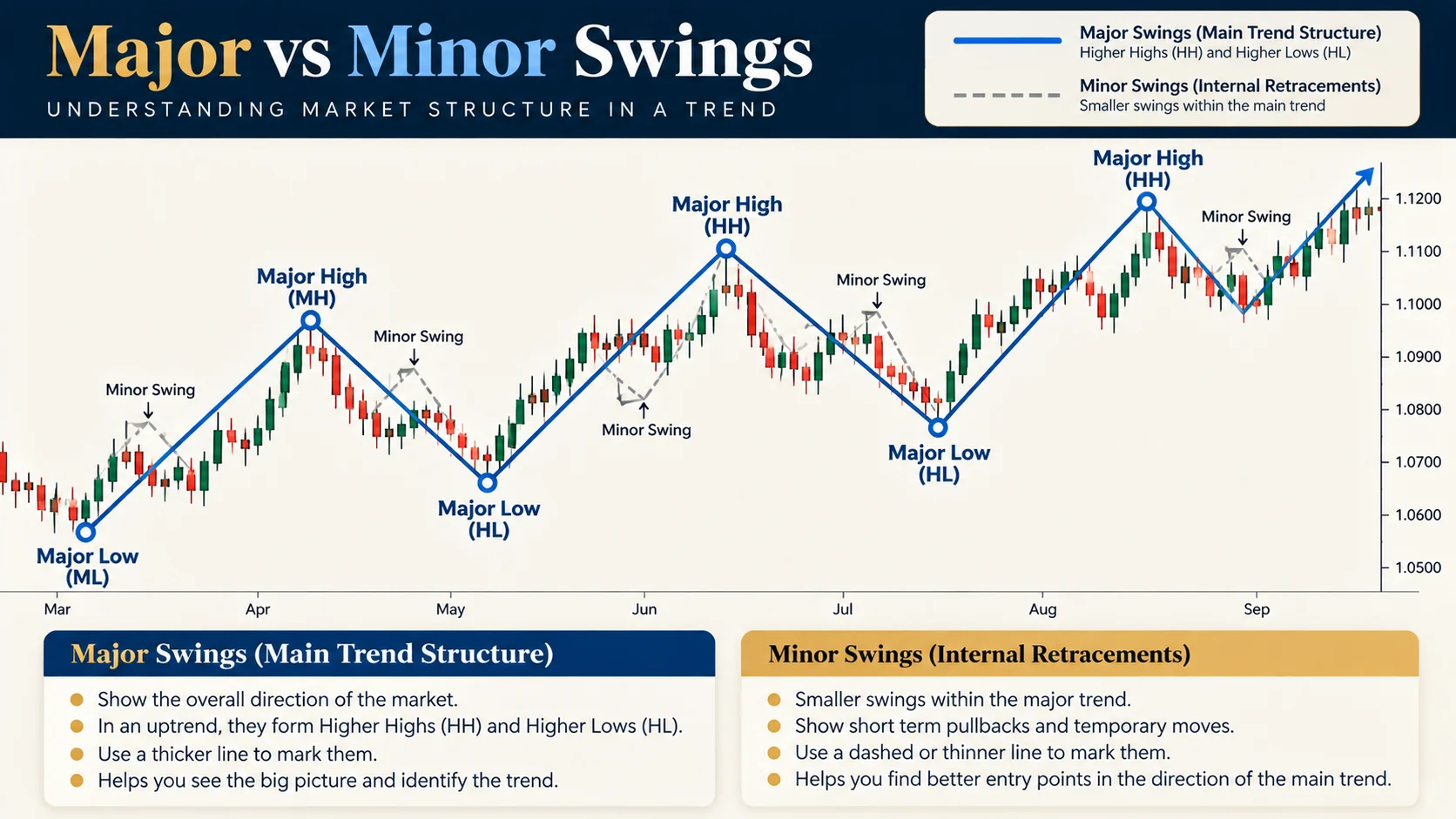
A major swing is not about how pretty it looks, it is about power. A major swing is a point that led price to break through an old wall. Imagine the price was stuck below 1.1000 for a week, and when it finally smashes through that level, the turn that started the push is a major swing. Minor swings stay inside the box, because they never break any walls and only wiggle around.
Here is another way to see it. If you draw a line from the bottom of a big move to the top, everything inside that line is a minor swing, and those are just small breaths the market takes along the way.
Most people fail here because they treat every wiggle as a big deal. They see a small move and think the trend is over, when it is only the market breathing. The hard part is knowing when a small breath has actually turned into a change of direction, and How to Tell When a Pullback Becomes a Reversal in Forex gives you the signs I look for before I believe it.
Four Tests for a Major Swing
"Big" is not a rule, but these four tests are. A swing that passes at least three of them is major, and anything else is minor. I think of them the way a builder thinks of a plumb line, because they give you a straight answer when your eyes want to see what they hope for.
- It broke something. The move away from the swing broke a previous high or low. A swing that leads to a break of structure is doing real work.
- It took liquidity. Liquidity here simply means the stop orders that sit around old highs and lows. The swing itself poked beyond an obvious old high or low before turning, so those stop orders were collected there.
- It is visible on the 4 hour chart. If you have to zoom into the 15 minute chart to see it, it is minor by definition.
- The leg away from it is large. The move that followed is at least as big as the average daily range of the pair, not a few pips of drift.
EURUSD on the 15 minute chart was what my mentor trained me on, so during my first months in forex I traded it over and over. One day I saw a small pullback, decided the trend was reversing and sold, and for ten minutes it looked as though I was right, until the real trend on the 4 hour chart hit my stop. The swing I had sold from failed all four tests, but back then I had not yet learned to ask.
Guide to Mapping Market Structure Correctly
You need to be strict with your eyes, and this is how I map my charts now. My trading got a lot calmer once I had a fixed routine for drawing each line, and that routine is written out in full in How to Draw Market Structure on Forex Charts Step by Step.
Open a 4 hour chart and zoom out so you can see a few months of moves.
Find the points where the price broke a previous high or low, and mark them, because these are your major swings.
Switch to a 1 hour chart to find your entry, but keep those 4 hour lines on your screen. Lower timeframes can fool you in their own ways, and How to Trade Micro Market Structure on Lower Timeframes explains why and how to handle them.
Ignore any moves that stay between your major lines. These are minor swings, so do not let them trick you.
Only trade in the direction of the major swing, and use the minor swings only to wait for a better price. When it comes to actually pressing the button, How to Use Market Structure Entry Signals in Forex shows the signals I wait for so I am not just guessing.
This simple change kept me from trading every little bump, and it saved my account.
Applying Major and Minor Swings to Your Trading Strategy
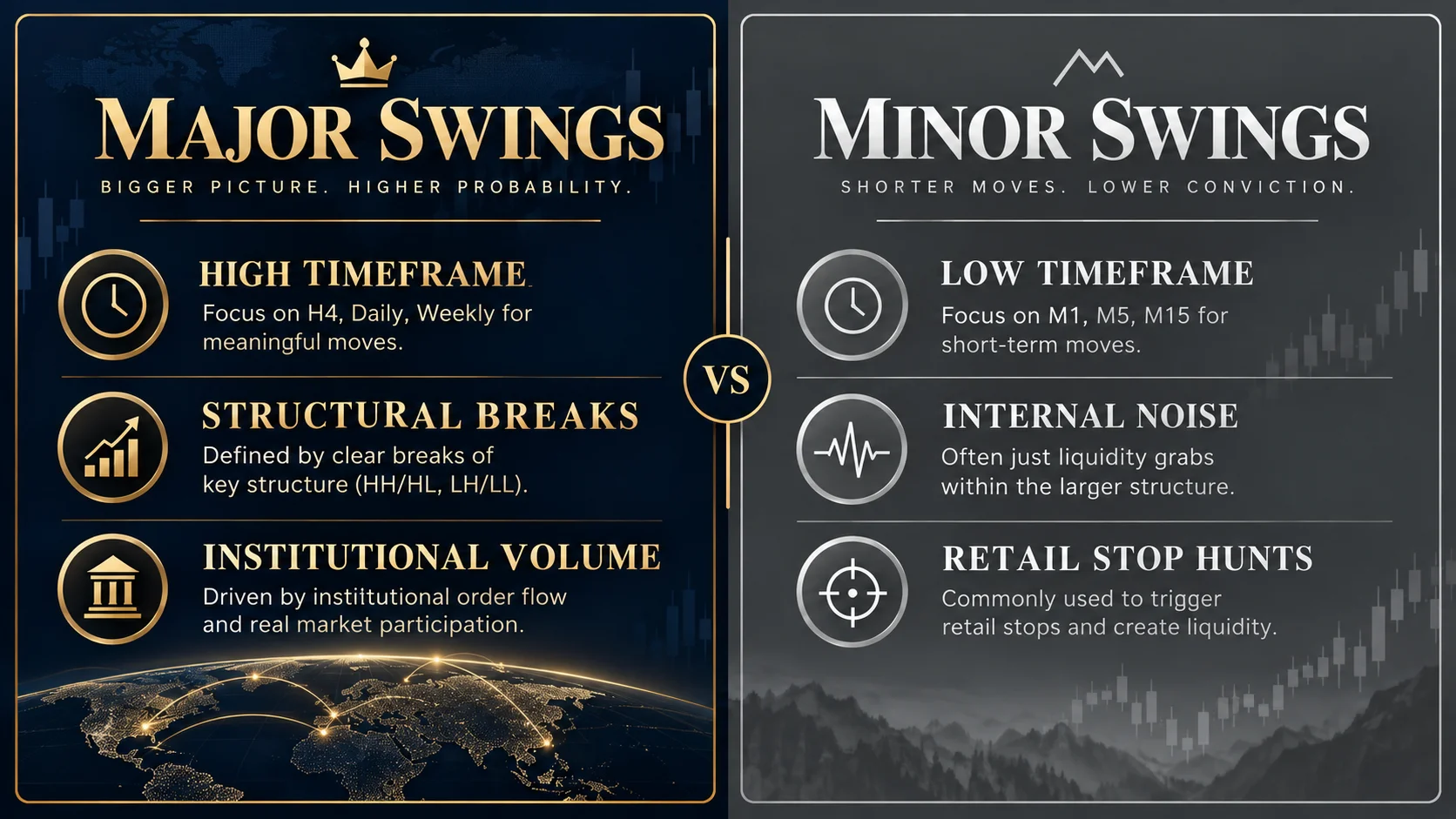
Knowing the difference is only half the battle, because you also have to change how you trade and map the charts. If the price pulls back to a minor swing point, do not sell. The banks are likely using that spot to buy more and trap sellers with that small move, since they want you to sell so that they can buy from you. Their plans become much easier to see once you can spot the moment the structure flips, which is what What Is a Market Structure Shift in Forex and How to Trade It? is all about.
If you wait for the price to reach a major swing area, you are trading with the banks. Your stop loss can then go behind the major swing, where it is much safer. If you hide your stop behind a minor swing instead, the market will hunt it down every time.
What Each Type of Swing Is For
Once you can tell them apart, each type of swing has its own job:
- Major swings set your stops and targets. A stop behind a major swing is protected by real structure, and the next major swing in your direction is your natural target.
- Minor swings time your entries. A small pullback inside a major move is where you get a better price, as long as you are trading in the direction of the major swing.
The same split shows up in another popular way of describing structure, where the main swings form the external range and the smaller swings form the internal structure inside it. If you want to trade those two layers together, I explain how in What Is Internal vs External Market Structure in Forex?.
Reality Check
You will not get good at this in an hour, because it takes time and patience held together with discipline. You have to sit with your charts, mark the levels and then watch what happens, and you will still get trapped sometimes, which is simply part of the game.
The only way to get better is to put in the time, so spend weeks looking at old charts and training your eyes. Think of it like laying the foundations of a house, where nobody sees the work but everything above depends on it. While you do those long practice sessions, keep How to Identify Higher Highs and Lower Lows in Forex open beside you, since labelling highs and lows is the base every swing sits on.
Where To Read Next
If you want to keep learning, these are the ones I would read next.
- How to Read Forex Market Structure on a Raw Chart
- How to Use Market Structure Entry Signals in Forex
- What Is a Market Structure Shift in Forex and How to Trade It?
- How to Find Daily Bias in Forex Without Forcing Direction
- How Much Time Do You Need Every Day to Trade Forex?
- The Best Forex Brokers in 2026 and Which One to Use for What
Frequently Asked Questions
What is the difference between major and minor swings in forex trend analysis?
Major swings are the turning points that drive the trend, because they break structure, take out stop orders and are clear on the 4 hour chart. Minor swings are the smaller turns inside those moves.
How do I know if a swing high is major or minor on my chart?
Use the four tests: did the move away from it break a previous high or low, did it sweep an old level first, is it visible on the 4 hour chart, and was the following leg large? Three or more yes answers make it major.
Where should I put my stop: behind a major or a minor swing?
Put it behind a major swing whenever you can. Stops behind minor swings sit right where the market often hunts for stop orders.
Can a minor swing become a major swing?
Yes. If price leaves a small swing and goes on to break an important high or low, that swing has proven itself and you should promote it to major.
Can I trade minor swings profitably as a day trader?
Yes, if you use them only to enter in the direction of the major swing. Using them to bet against the main move is where most losses come from.
If this helped you, send it to a friend who is learning to trade.