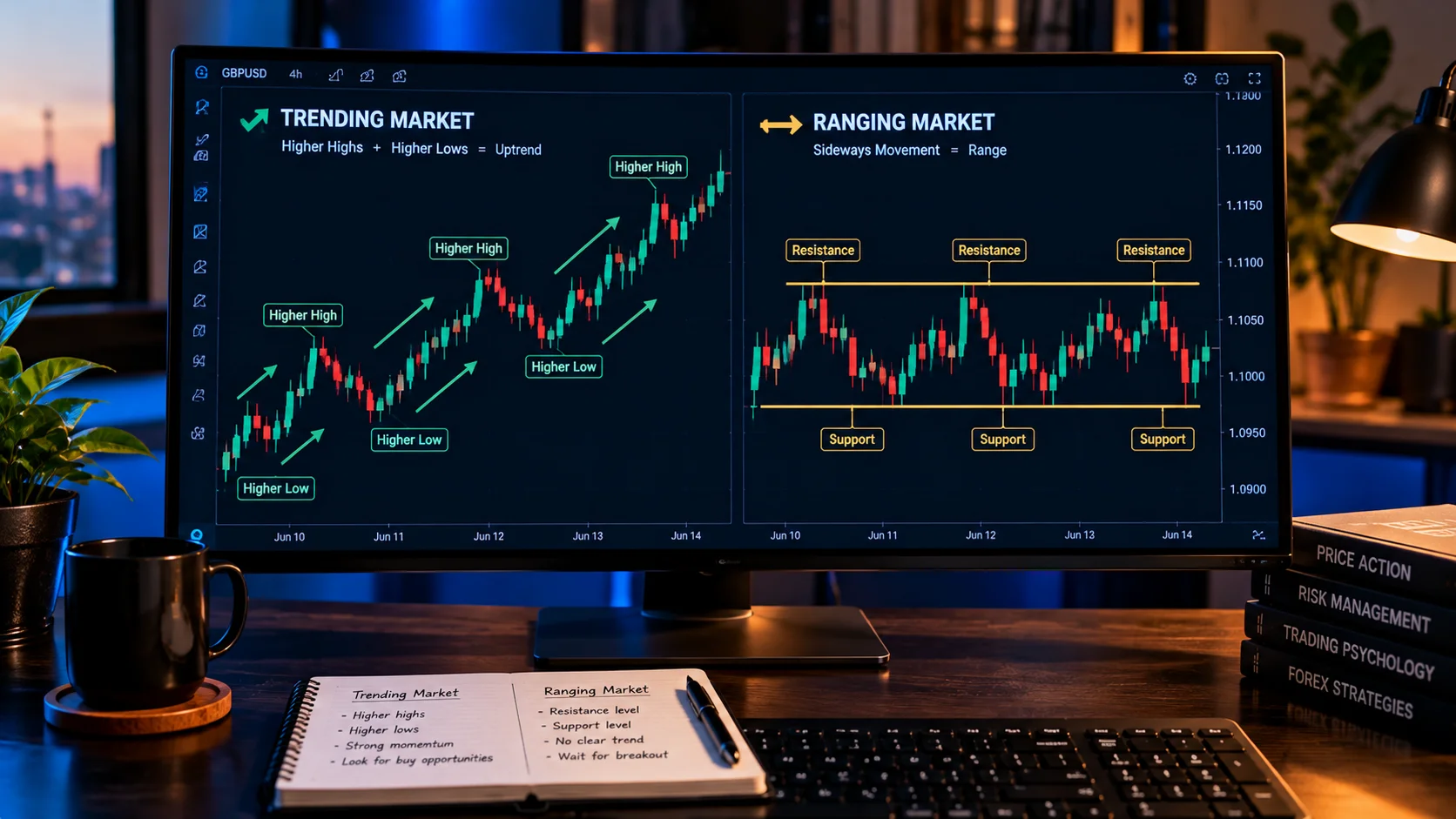
For about my first two years of trading, my whole entry method was to wait for a high to break and then buy it, and I lost more money doing that than with any other single mistake. I was right about the break often enough to keep believing in it, and wrong about the timing often enough to keep losing, because price would break the level, pull straight back into it, take my stop and only then carry on in the direction I had expected.
What I finally understood is that a break of structure tells you what the market has just done, not where you should click buy. You still need a reason to enter, a place for your stop that makes sense, and ideally a better price than the breakout candle itself, and that is what market structure entry signals give you. Below I go through the entries I now use after a break and how each one keeps you out of the trap I sat in for so long.
How Market Structure Actually Works
Big banks cannot buy or sell everything at once, because if they tried, they would push the price so far that their own buying would become too expensive. They need to find people on the other side to trade with, which is why you see the price spike past a high and then crash back down. That spike is a trap set where lots of orders are waiting, and traders call those waiting orders liquidity. It hits the "stop loss" orders of small traders like you and me, and when those stops are hit, they become the very orders the banks need to get into their own trades.
Once the banks are in, the market moves. I started seeing the market very differently when I realised this, because so much of it is about money moving from small traders to the big players. As a small trader, it is your job to learn how to swim with their tide if you want to survive.
Why Your Early Entries Keep Getting Trapped
You see the price break a high, you decide the trend has changed, and you buy, and a few minutes later you are losing. This happens because you did not wait for a real shift. The first skill to build here is reading the swings themselves, and How to Identify Higher Highs and Lower Lows in Forex shows you how to tell when a trend has truly changed before you put any money in.
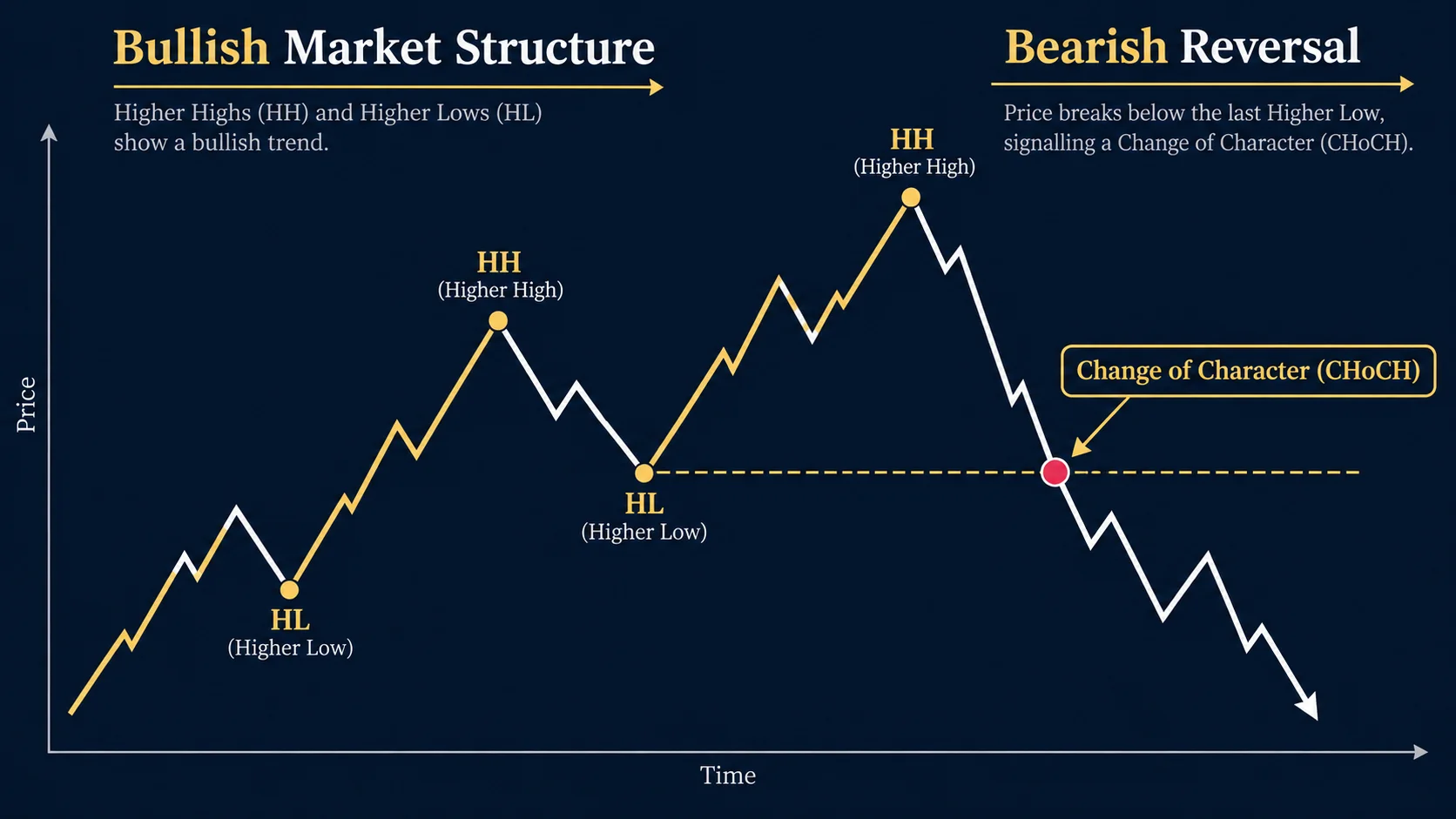
Think of a person who is usually quiet but suddenly starts shouting, because you know straight away that something has changed. In the market we call this a CHoCH, which stands for Change of Character. It is the first sign the trend might turn, but it is not a trade yet. A break of structure, or BOS, is when the price breaks a level and keeps going in the same direction. These two ideas sit on top of everything else in this lesson, and How to Read Forex Market Structure on a Raw Chart is the place to see them on a clean chart from the ground up.
The Three Best Market Structure Entry Signals
I rely on three signals to find my entries, and the first is the order block. Think of a heavy boot print left in the mud. When a bank buys a huge amount, it leaves a zone like that behind, which traders call an order block, and when the price comes back to this zone, it often turns around. Traders call that return "mitigation", which simply means price coming back to finish business at that zone. If you are curious about who these big buyers and sellers actually are, What Is the Forex Market and Who Trades It paints that picture in plain words.
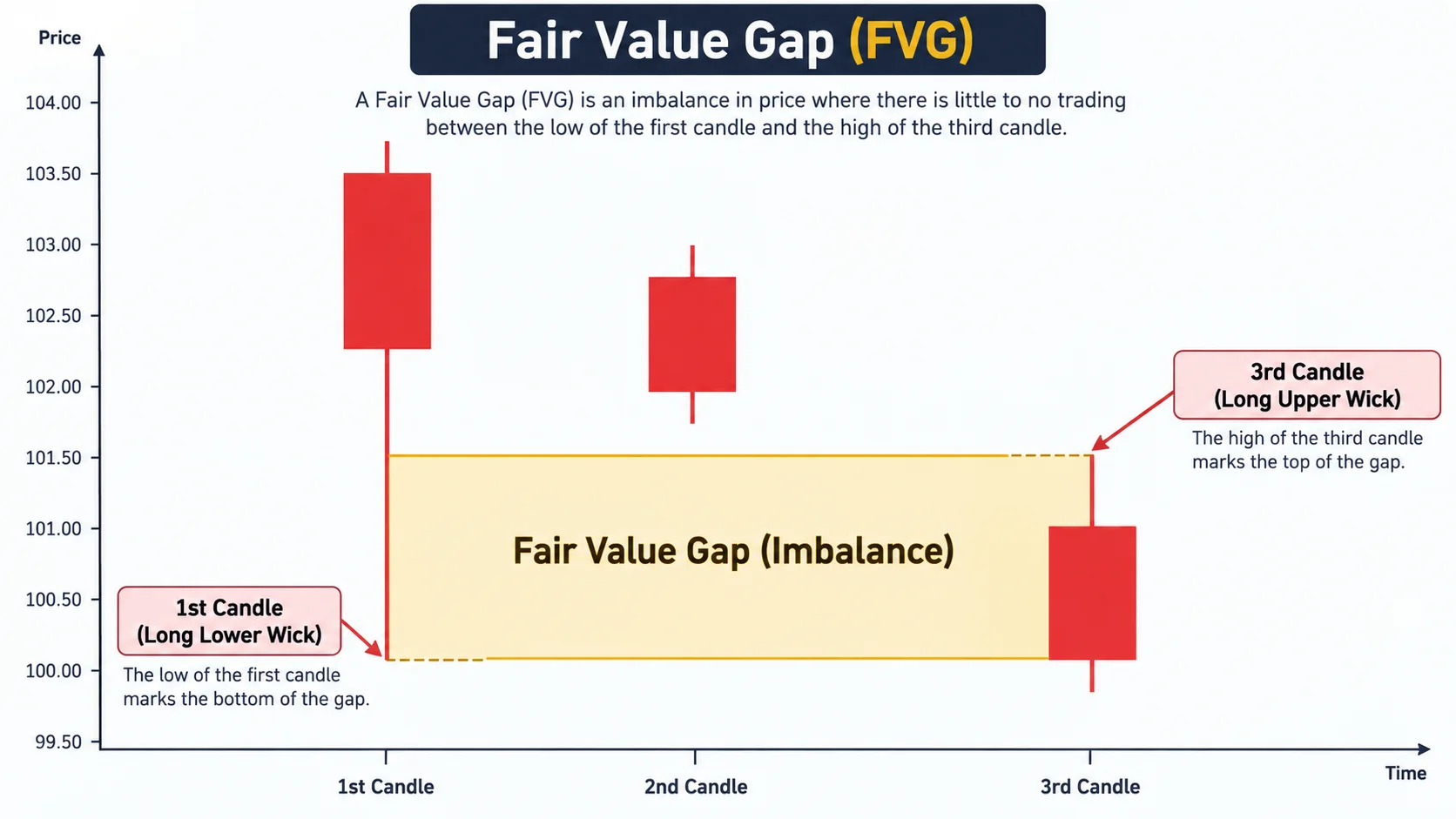
The second is the fair value gap. When a car drives really fast, it leaves a gap behind it on the road, and in the market, when the price moves very fast, it leaves a gap where only one side was trading. The market usually wants to come back and fill that empty space.
The third is the high low confirmation. You wait for the price to break a level, pull back to touch it, and then show that it is rejecting that level, and I like this one best on pairs like EURUSD or GBPUSD. The hard part is knowing whether a pullback will hold or turn into something bigger, and How to Tell When a Pullback Becomes a Reversal in Forex goes through the clues I look for before I time my entry.
How to Map Your Direction Before Looking for Entries
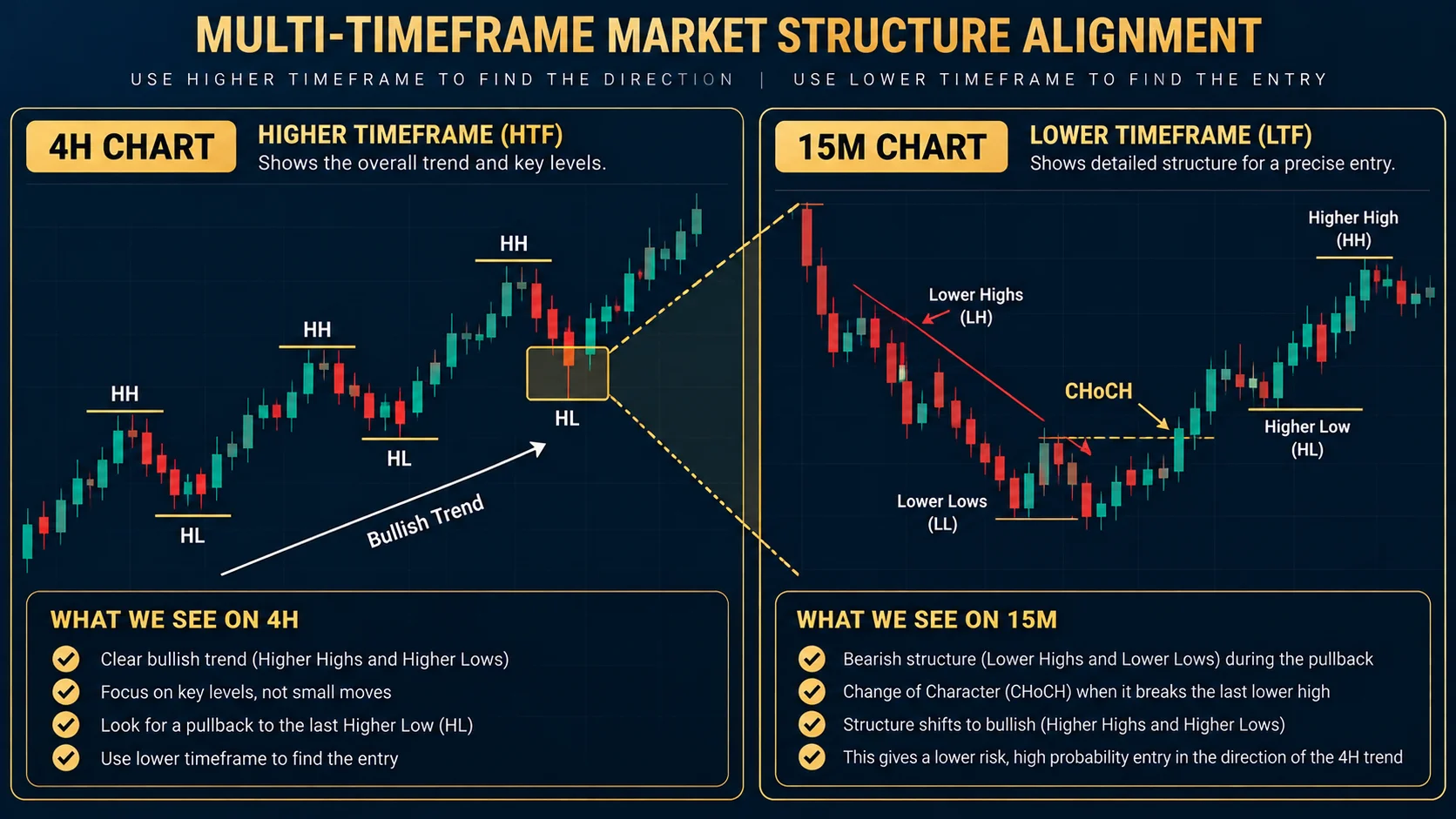
You must know which way the market is heading first. I look at the 4 hour chart to see the big picture, and if the 4 hour chart is going up, I only look for buy signals on my 15 minute chart. The small chart and the big chart often tell different stories, so before you trust the 15 minute chart, read What Is Internal vs External Market Structure in Forex? to see how the small moves fit inside the main trend.
If you trade against the big trend, you get hit with drawdown. Drawdown is when your open trade is losing money before it (hopefully) turns into profit, and if you have too much of it, you will panic and close the trade too soon. Lining up your timeframes keeps your drawdown small. A deep drawdown is also how accounts end up in real trouble with their broker, which is why I would read What Is Margin Call in Forex and How to Avoid It next to see how small drawdowns keep your account safe.
A Step by Step Checklist for Your Next Trade
Use this plan every time you sit down and look at your charts:
Find the big trend on the 4 hour or daily chart.
Wait for the price to reach a key high or low area.
Switch to the 15 minute chart and wait for a change of character.
Find the order block or fair value gap that started that change.
Set a limit order at the start of that zone, and put your stop loss just past the high or low.
The Hidden Mistakes That Keep Small Traders Stuck
Your brain will try to trick you. You will see a big candle and feel that you have to buy right now, and that feeling is FOMO, the fear of missing out. If you chase the market like that, you end up buying at the worst price.
Also, do not set your stop loss too tight. If you set a stop of only 2 or 3 pips, the normal "noise" of the market will kick you out of the trade before it has a chance to work. The small charts are where that noise feels loudest, and How to Trade Micro Market Structure on Lower Timeframes shows how the big banks move on the smallest charts so the noise stops catching you by surprise.
Putting It Into Practice and a Reality Check
Knowing all this is not enough, because you have to practise it. Use a demo account for six months, and expect to sit on your hands for hours at a time. If you cannot wait for the right setup, you will not succeed, since this is not a get-rich-quick scheme but a slow way to build skill. It is a lot like planting a field, where the work you put in during the quiet months is what decides the harvest. Before you risk your hard-earned money, have a look at Is Forex Demo Trading Worth It for Beginner Traders? because it shows how to use a demo to train your patience properly.
Where To Read Next
If you want to keep learning, these are the ones I would read next.
- How to Read Forex Market Structure on a Raw Chart
- What Is a Market Structure Shift in Forex and How to Trade It?
- How to Find Daily Bias in Forex Without Forcing Direction
- How to Draw Market Structure on Forex Charts Step by Step
- How Much Time Do You Need Every Day to Trade Forex?
- What Is the Forex Market and Who Trades It
Frequently Asked Questions
How do I identify high-probability market structure entry signals?
Wait for a change of character on a 15-minute chart that matches your 4-hour trend. This makes sure you are trading in the same direction as the bigger market move.
What is the difference between BOS and CHoCH in forex?
A CHoCH is an early sign that the trend may be turning, while a BOS shows that the current trend is carrying on.
Can I use market structure entry signals on a small $100 account?
Yes. Use small position sizes so that your risk on each trade is only one or two dollars.
Why do my market structure entries keep getting stopped out?
You are probably entering too early. Wait for the price to pull back into an order block or fair value gap before you get in.
What is the best timeframe for market structure entry signals?
I use the 4-hour chart to find the trend and the 15-minute chart to time my entries. Together they give a good balance between accurate entries and keeping risk under control.
If this helped you, send it to a friend who is learning to trade.