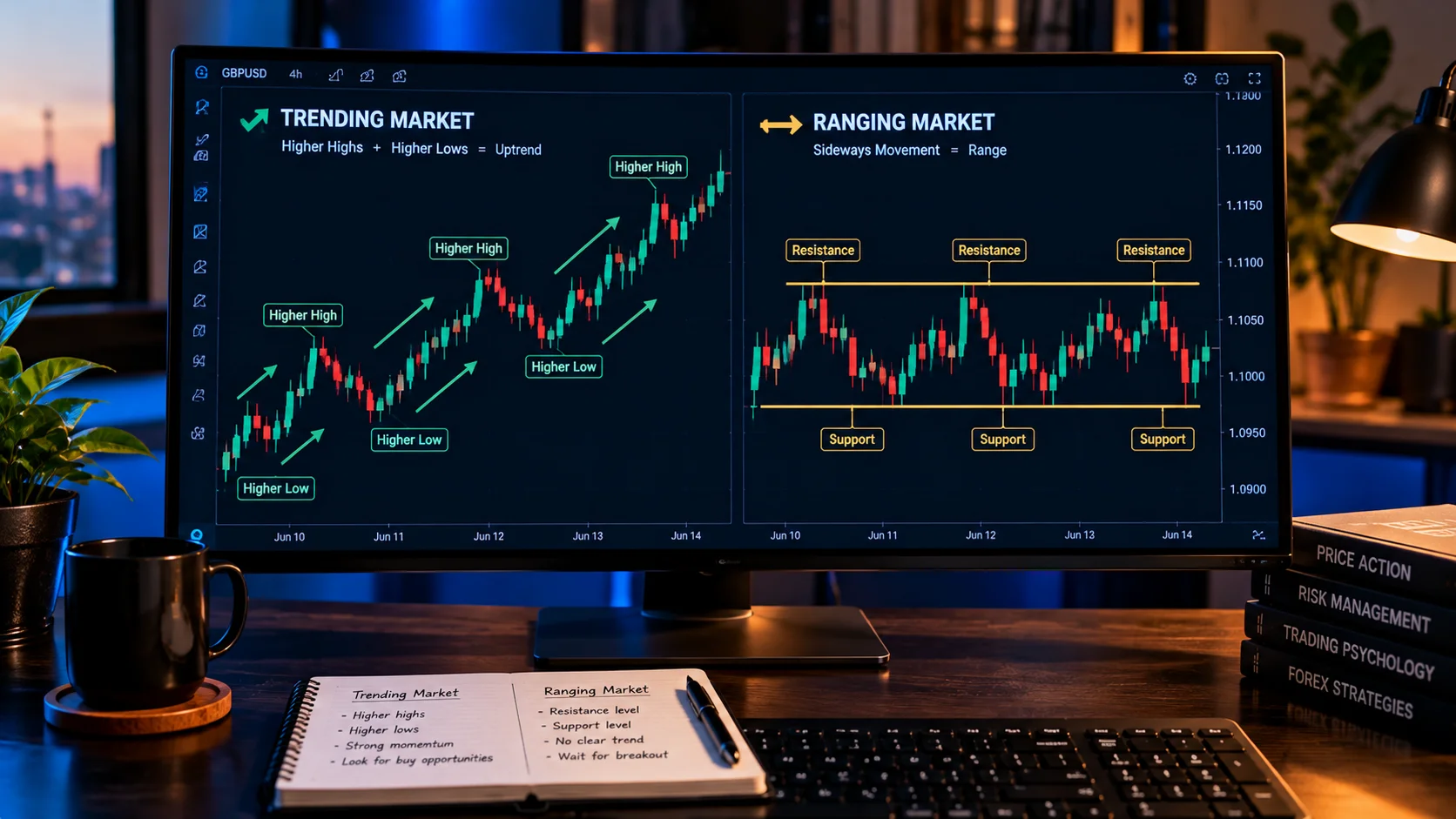
If you have spent any time on trading YouTube or Instagram in the last few years, you have seen charts covered in labels like BOS, CHoCH, FVG and OB, and you have probably been told that smart money concepts are the hidden trick the banks do not want you to know about. I want to start by taking some of that mystery away, because once you remove the jargon, SMC is a fairly sensible way of looking at where large orders are likely to sit and why price often runs to those places before it turns.
The part that matters is this. A bank or fund that wants to buy hundreds of millions of euros cannot do it with one click without pushing the price against itself, so it needs other traders to sell to it, and some of the most reliable sellers are the stop losses sitting just under obvious lows. When price dips through those lows, those stops turn into sell orders, the large buyer gets filled, and price often climbs back. Below I explain the handful of SMC ideas a beginner actually needs, in plain words, and where people go wrong when they treat the labels as if they can never fail.
What Is Smart Money Concepts in Forex?
Smart money concepts in forex is just a way to read the chart by following the biggest players, which are the banks and large funds. They move the most money, so they are the ones who move the price.
Many everyday traders use indicators that lag behind price and trendlines the market simply ignores. For a long time I drew trendlines everywhere, and it made me furious when price poked above my line, hit my stop and then fell exactly where I had expected it to go, which made the whole thing feel almost personal. Things only changed when I stopped staring at lines and started looking at where the big orders were sitting, because that was when the chart finally began to make sense.
How Smart Money Concepts Actually Work in the Live Market
To understand how smart money concepts in forex work, look at an "order block." Think of a big company buying fuel. It does not buy it all at once, because that would push the price up on itself, so it buys in small parts to keep the price steady, and at the same time it leaves some buy orders behind at certain levels.
Before we go further, let us slow down on the term order block, because it comes up in almost every smart money discussion you will ever read.
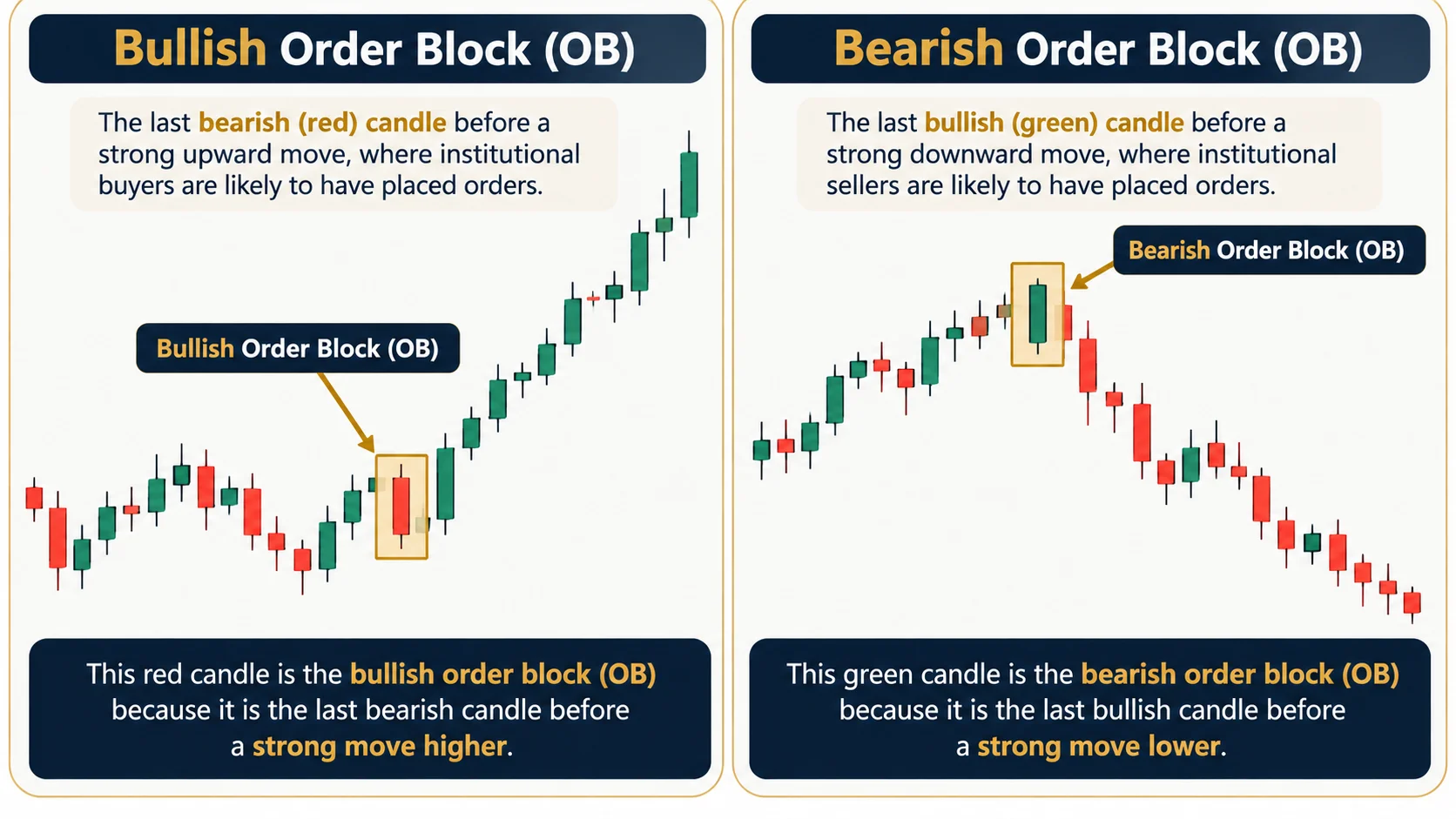
An order block is the last candle before a big move in the opposite direction, and it shows where the big money started its push. When price comes back to this candle later, those large players often still have orders left to fill, and they use that level to push price again. Seeing these zones takes a trained eye at first, and my lesson on How to Draw Market Structure on Forex Charts Step by Step is where I show how to mark them on your own screen.
Imagine the GBPUSD pair. Suppose price drops, hits a level, and then flies up quickly, so that last candle before the flight is your order block. If price comes back to that spot weeks later, it often stops there to "fill" the rest of the orders, and I have seen this happen hundreds of times. You enter when price reaches that zone, keep your stop tight, and aim for a move three times the size of your risk.
An Easy Guide to Smart Money Concepts for Beginners
There are really only three main things you need to know when you start, so let us take them one at a time.
1. Market Structure (BOS and CHoCH)
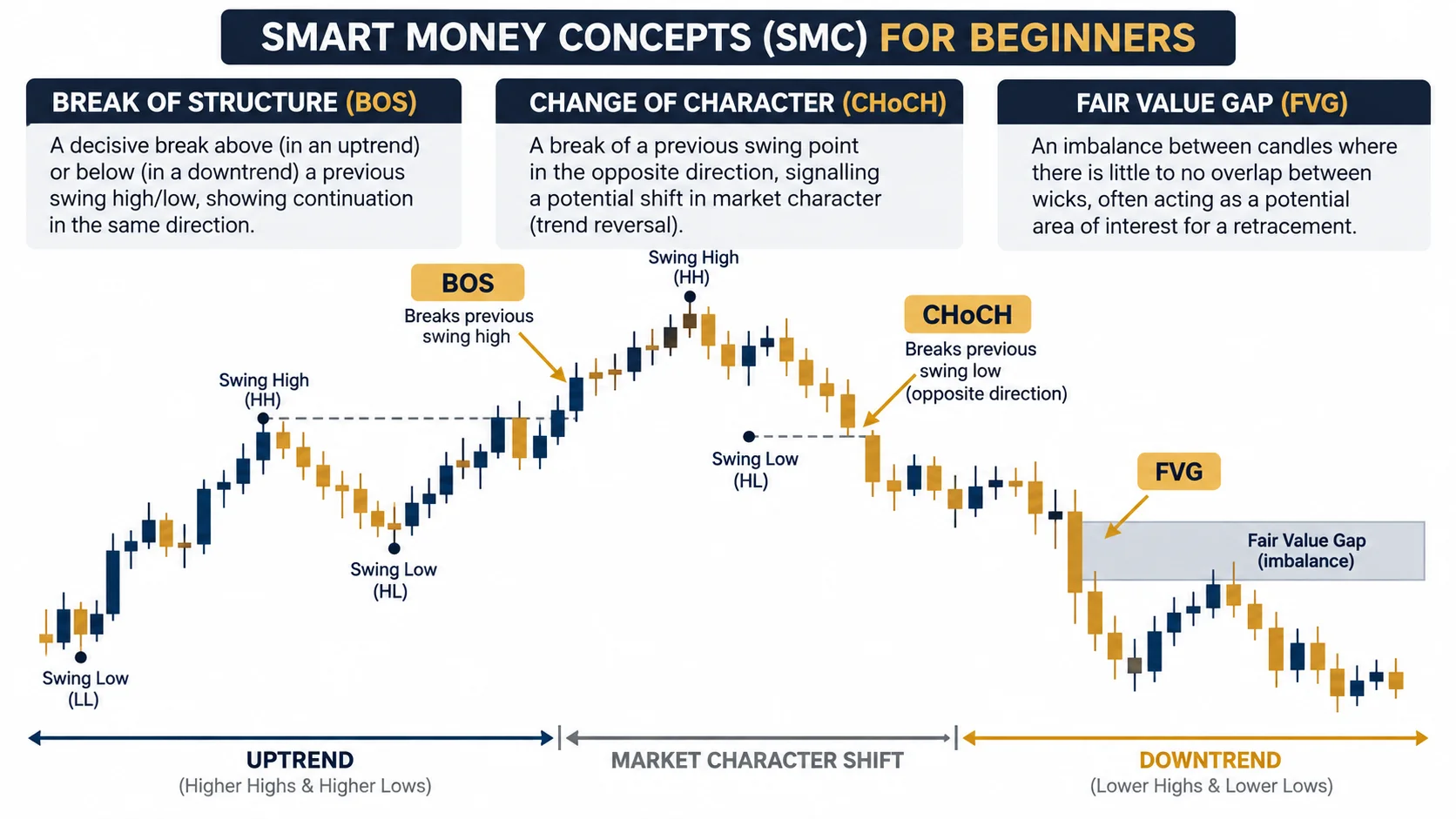
Market structure is simply the direction of the trend, shown by the highs and lows price leaves behind. When price breaks a high, it is a Break of Structure (BOS), and it tells you the trend is healthy. When price fails to make a new high and breaks a low instead, it is a Change of Character (CHoCH), which is a warning that the trend might be turning around. Reading these breaks well depends on seeing the whole chart first, and How to Read Forex Market Structure on a Raw Chart builds that habit with clean, simple examples.
2. Liquidity Pools
Liquidity is the fuel that keeps the market moving, and in SMC it mostly means a pile of stop loss orders. A liquidity pool is just a spot where lots of these orders sit together, usually above old highs and below old lows. The market is pulled toward these spots because the big players need those orders to fill their own positions.
3. Fair Value Gaps (FVG)
Sometimes the market moves so fast that it leaves a gap where buyers and sellers were not matched. On a chart, this looks like an empty space across three candles. The market does not like to leave these gaps open, so it usually comes back to "fill" them later, a bit like the tide coming back in to cover the sand it left dry.
Why the Hype Around Smart Money Concepts in Forex Can Be Dangerous
Beginners love to mark every single gap on their chart, and they think every block is a trade, which is a mistake. An order block only works if the big trend supports it. Knowing which way you want to trade before the day starts takes away a lot of the guessing, and How to Find Daily Bias in Forex Without Forcing Direction is the method I would use to set that direction.
Pride catches plenty of traders too. They think they are above people who use old support levels, so they fill their charts with so many lines and boxes that the price disappears, which is what people call "analysis paralysis." I spent months moving lines around while ignoring the simple truth of the trend, and my results only changed once I cleared my chart, stopped overthinking and started trading with the bigger players instead of against them. The trend is the thing all those boxes should agree with, and if it still feels unclear to you, How to Identify Higher Highs and Lower Lows in Forex goes back to the plain highs and lows that show it.
How to Start Using SMC on a Small Account
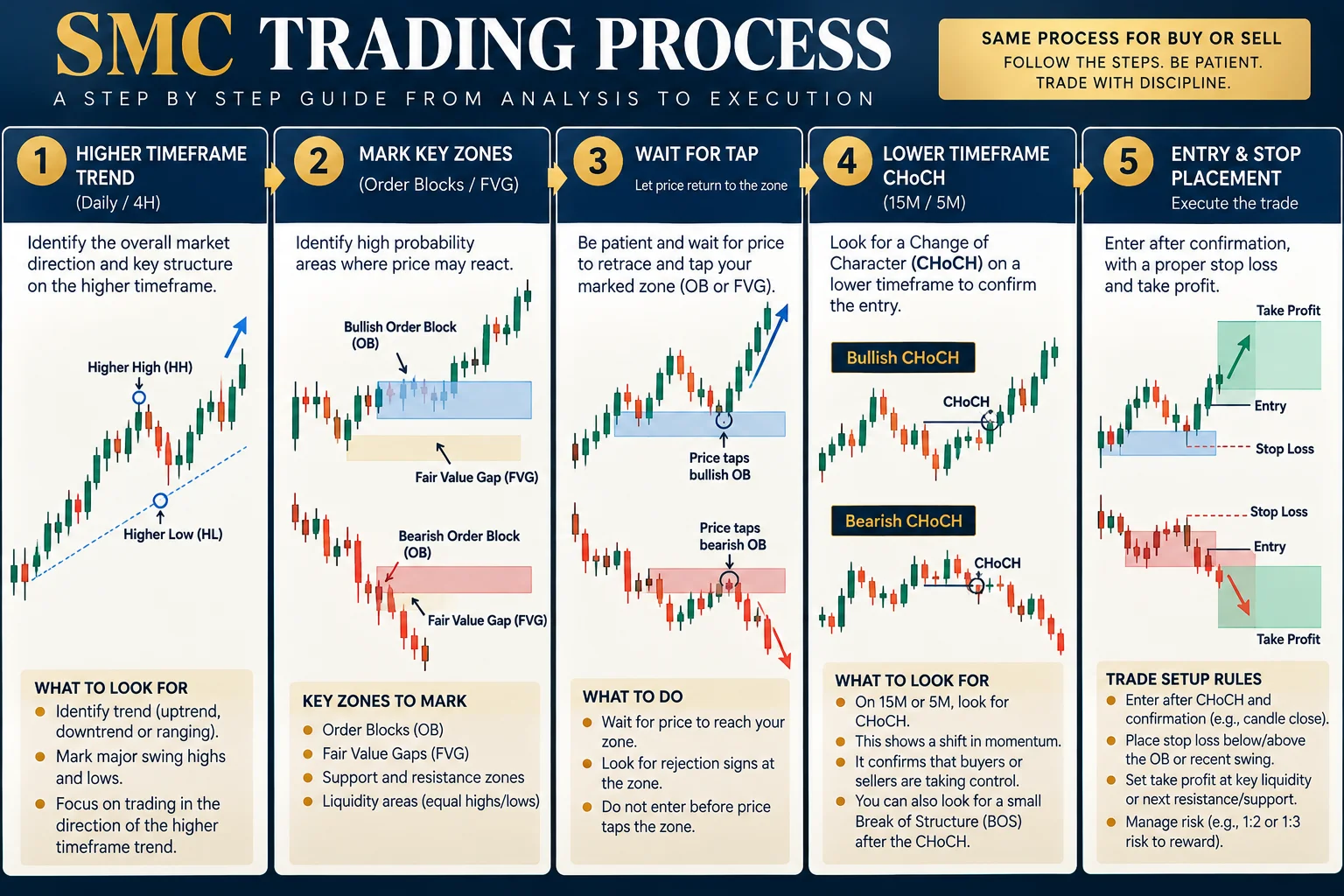
If you have a small account, you need tight stops, so here is a simple plan to follow:
Check the 4 hour chart and ask which way the trend is going, then only trade in that direction.
Mark the recent order block or gap on that bigger chart.
Wait for price to reach your zone, and do not chase it if it runs without you.
Go to the 15 minute chart and wait for a CHoCH to show that price is turning your way. Spotting that turn at the right moment is a skill on its own, and What Is a Change of Character in Forex and How to Trade It? shows the signs that the push is really swinging in your favour.
Enter the trade and put your stop just behind the recent low or high.
This takes patience, and you might wait three days for one good setup. But when it works, the reward is often worth the wait. While you sit and wait, it helps to recognise when a trend is simply carrying on, and What Is BOS in Forex and How Do You Trade It teaches you exactly that.
The Truth About How the Big Players Trade
The banks do not know who you are, and they are not hunting your stop loss personally. They are just moving huge amounts of money, and SMC is only a tool to help you see where that money is likely to go. If you are curious about who these players really are and how much they trade, What Is the Forex Market and Who Trades It gives you a clear picture of the whole market.
You will not get rich overnight, because it takes a long time to learn this properly. If you find a simple support level that lines up with an order block, that is great, so use both. Keep your charts clean and always protect your money first. Before you put your hard-earned dollars on any of these setups, be honest with yourself about what your account can handle, and How Much Money Do You Need to Start Trading Forex helps you work that out.
Where To Read Next
If you want to keep learning, these are the ones I would read next.
- How to Read Forex Market Structure on a Raw Chart
- How to Use Market Structure Entry Signals in Forex
- What Is a Market Structure Shift in Forex and How to Trade It?
- How to Find Daily Bias in Forex Without Forcing Direction
- How Much Time Do You Need Every Day to Trade Forex?
- How to Use Smart Money Concepts for Retail Trading Strategy
Frequently Asked Questions
What is smart money concepts in forex?
It is a way to trade by following how the big banks move money. It uses structure and liquidity to find good quality trades instead of relying on slow indicators.
Is SMC better than support and resistance?
Not necessarily, and many traders use both together. SMC explains why the price reacts at a level, while support and resistance just show where it reacts.
How much money do I need to start trading SMC?
You can start for free on a demo account. When you move to real money, start small, because even with 100 dollars you can use these ideas to manage risk well. Never risk more than 1 or 2 percent of your account on one trade.
What does CHoCH mean in forex trading?
It means "Change of Character." It is a sign that the trend might be ending, because price broke a recent high or low that it should have respected.
Can beginners learn Smart Money Concepts easily?
Yes, but you have to unlearn some old habits first. Focus on how price moves rather than on indicators, and remember that it takes time to see these patterns on a live chart, so be patient with yourself.
If this helped you, send it to a friend who is learning to trade.