
You mark a high, price breaks it, you buy because the trend is obviously turning up, and within an hour price has turned around and taken your stop. If that has happened to you more than once, you are not unlucky. You were trading a break that had not earned your trust yet, and a market structure shift in forex is the idea that helps you tell the two kinds of break apart.
A real shift is not just any break of a high or low. It is a break that comes after price has first run through an obvious pile of stop losses and then moved hard in the opposite direction, which tells you that the large orders waiting there have been filled and the market is now willing to travel the other way. Once you learn to wait for that order of events, you stop chasing the first move and start trading the second one, which is usually the one that pays.
How Market Structure Shifts Work Behind the Scenes
The market works like an auction where large banks and funds buy and sell huge amounts of money, but they cannot buy everything at once, because what they need first is enough people willing to sell to them. They find those sellers at the obvious spots on your chart. Most traders put their stop losses just below a low, so the big players push the price down into those stops, and every stop that gets hit becomes a sell order. Traders call this a liquidity sweep, where liquidity simply means the orders waiting at a price. Once those sell orders go off, the big players buy them all up, and with no sellers left, the price shoots up. That fast, forceful move away from the level is called displacement, and it is the footprint big money leaves behind. Does that make sense?
BOS, CHoCH and MSS: How They Fit Together
These three terms get mixed up all the time, so this is the simple version I use myself:
- Break of structure (BOS): price breaks a swing point in the direction of the trend, which means the trend is carrying on.
- Change of character (CHoCH): price breaks a swing point against the trend for the first time. It is a warning that the trend may be ending, nothing more.
- Market structure shift (MSS): a change of character that happens straight after a liquidity sweep, with fast, strong candles. It is the version with the big players' fingerprints all over it, and learning to read those fingerprints is what What Is Smart Money Concepts in Forex for Beginners is all about.
So every MSS is a CHoCH, but most CHoCHs are not an MSS, and that difference is where the whole advantage comes from. A plain CHoCH only tells you to be careful, and I go through how to handle one in What Is a Change of Character in Forex and How to Trade It?, while an MSS is the one you can actually build an entry around. These breaks also sit inside a bigger trend, and if you have ever wondered why a break on one level of the chart seems to ignore another, What Is Internal vs External Market Structure in Forex? clears that up.
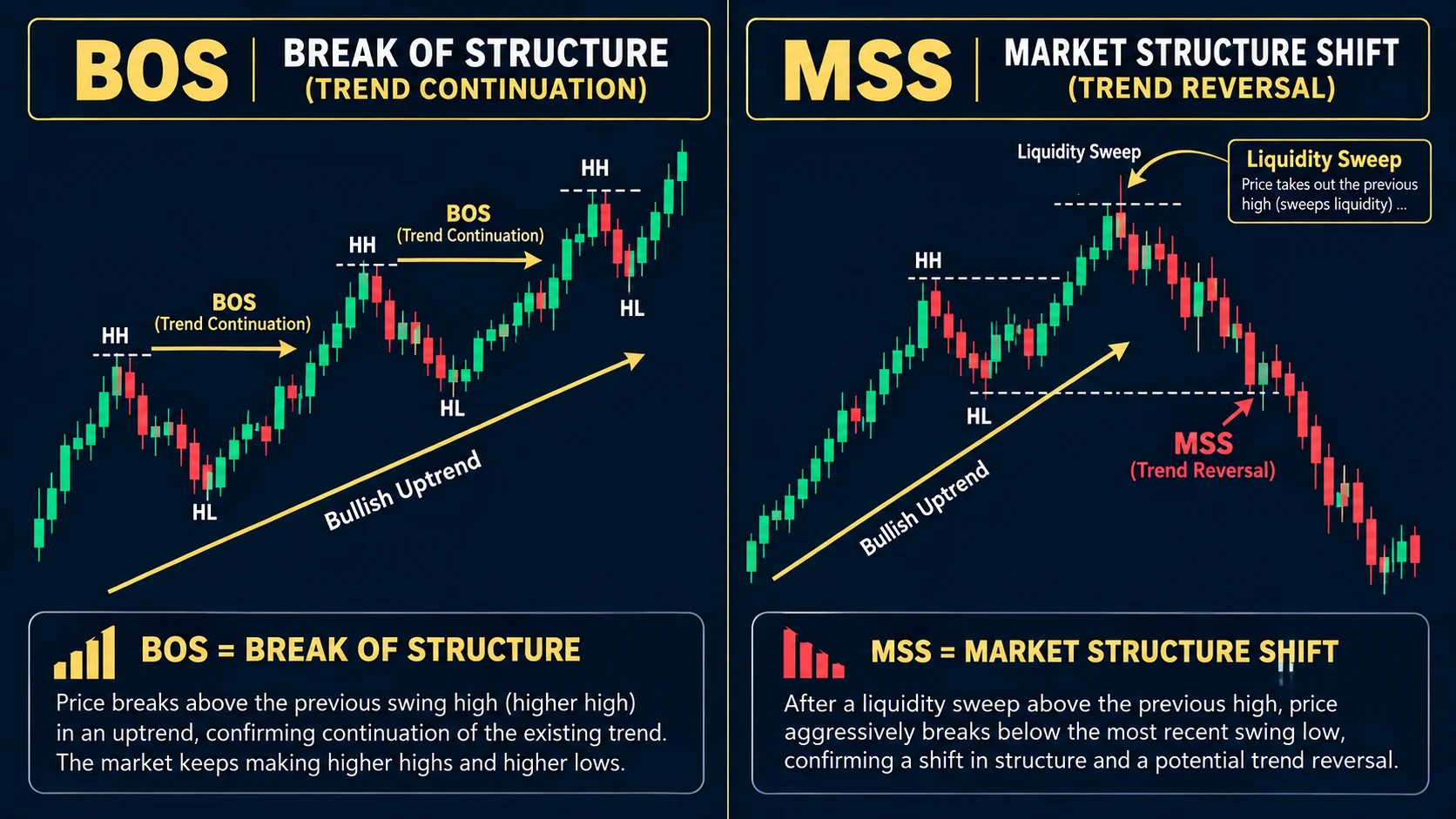
What Is a Market Structure Shift in Forex?
A market structure shift in forex is a pattern showing that power has moved from buyers to sellers, or the other way around. Think of a busy market. If you want to buy a huge amount of wheat, you need a crowd of sellers gathered in one place, and in trading, those crowds of waiting orders are the liquidity we talked about. When the big players step in, they make a splash, and that splash is the displacement, which often leaves a big, empty space on your chart. An MSS is when price hits a pool of these orders, turns around, and then breaks the most recent high or low with force, which shows that the big players have taken what they wanted and are now in charge. Spotting these on a live chart starts with marking the highs and lows correctly, so practise with How to Draw Market Structure on Forex Charts Step by Step until it feels natural.
The Three Elements of a Valid Market Structure Shift
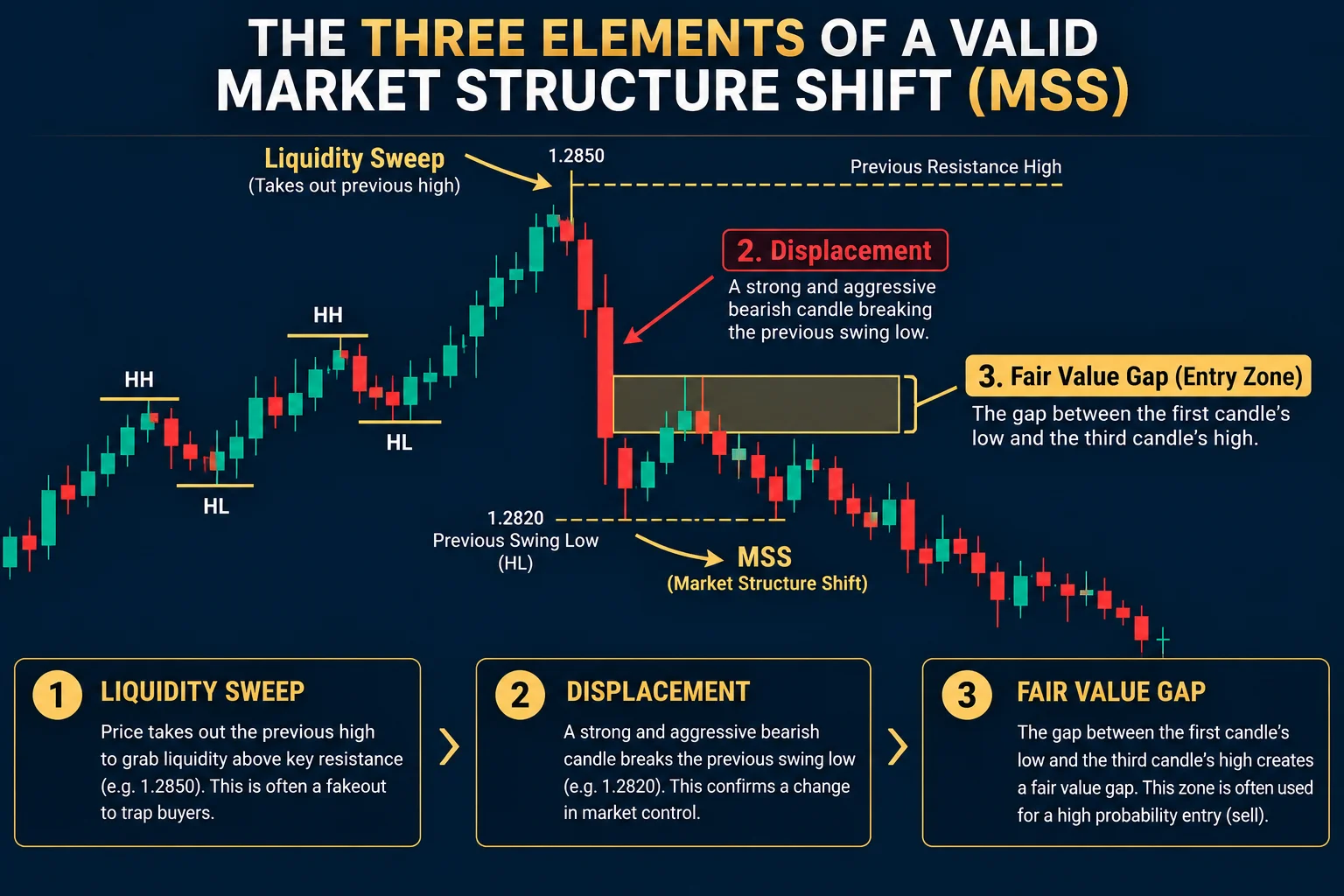
I only trade a shift if it has all three of the things below. It is like a recipe for bread, where leaving out the yeast does not give you slightly worse bread, it gives you something flat that is not bread at all, so if one piece is missing, I walk away. Knowing the pieces is one thing, but knowing exactly when to press the button is another, and How to Use Market Structure Entry Signals in Forex is there to stop you entering too early.
1. The Liquidity Sweep
Price must take out a high or a low first, which hits the stop losses of small traders sitting there. If price just turns around in the middle of nowhere, ignore it. Single candles at these levels often show you the trap as it happens, and How to Trade Hammer and Shooting Star Candles in Forex explains why so many traders lose their money right there.
2. Clear Displacement
After the sweep, price must move away fast, so look for big candles with real size to them. If the candles are small and messy, the big players are not interested in that level. The long wicks around the sweep often show you where the big banks stepped in, and How to Read Candlestick Wicks and Shadows in Forex Trading teaches you how to read what they are saying.
3. A Fair Value Gap
Think of a shop that runs out of bread, where the shelves sit empty until a truck eventually comes to fill them again. A fair value gap is an empty space between candles, and it means price moved so fast that not everyone got their orders filled. The market will often come back to fill that gap, just like the truck comes back to the shop.
Why Your Stop Losses Keep Getting Hit on Fake Shifts
Trading every single break on the chart is why most traders lose, because they never look at the big picture. When I first started, I traded every 5 minute break I saw, and five minutes after entering I would usually be stopped out. I once lost four trades in a row on the same pair because I was trading against the daily trend, and I could not see it because I only looked at tiny, noisy moves. So start from the higher timeframes and, if you use a small chart at all, keep it for the entry only, because a 5 minute shift only matters when it happens at a big level on a 4 hour or daily chart. If reading a bare chart still feels like guesswork, go back to How to Read Forex Market Structure on a Raw Chart and get comfortable there before you worry about the finer details.
How to Trade Market Structure Shifts With Confidence
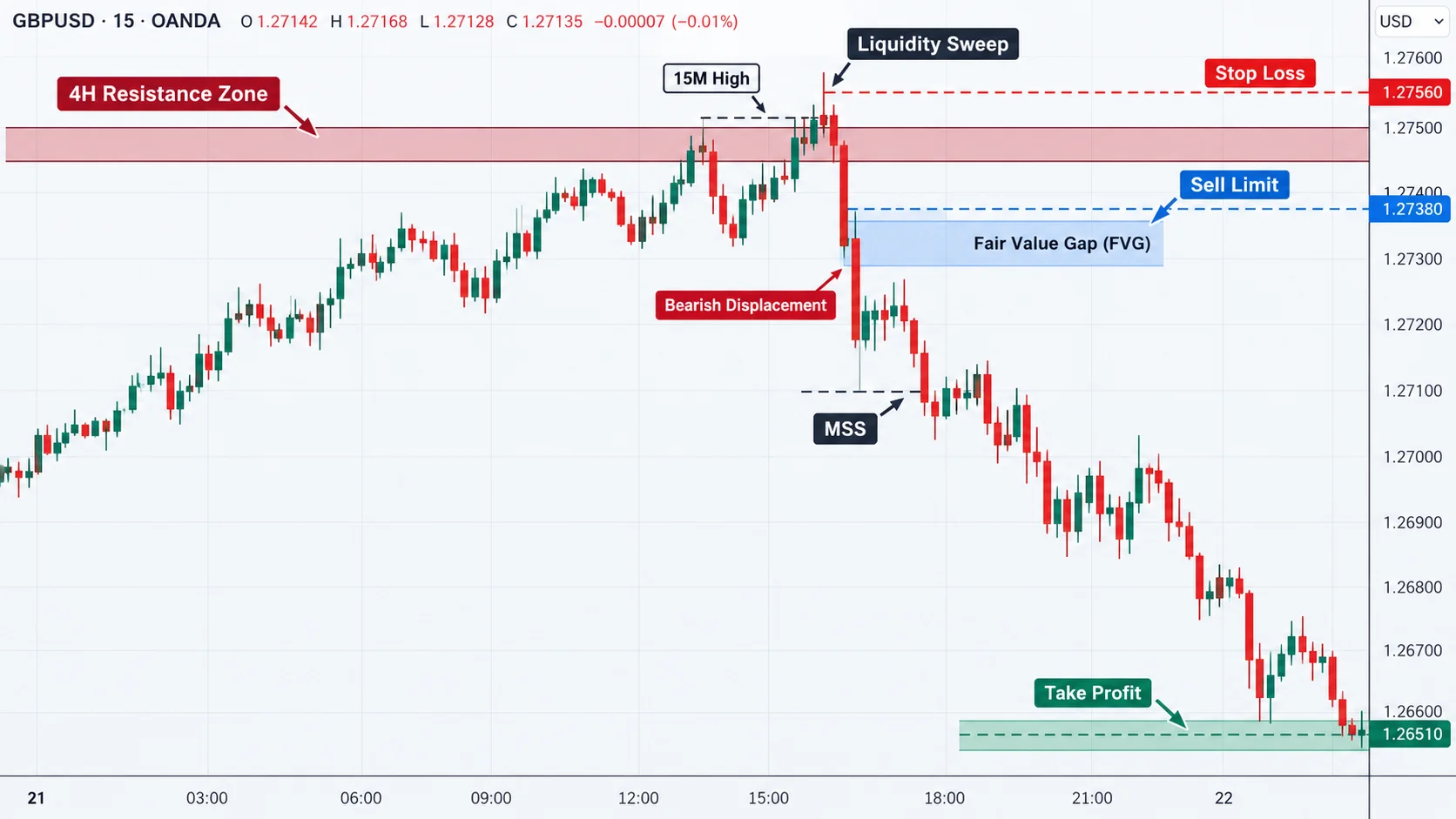
Let us walk through a real example. Imagine you are watching GBPUSD while the big trend is down, and the price moves up into a 4 hour supply zone, which is an area where sellers stepped in before.
Find the big level: Price hits 1.2550 on the 4 hour chart.
Go to the lower timeframe: Switch to the 5 minute chart and watch from there.
Wait for the sweep: Price pushes up and sweeps a high at 1.2560.
Look for the shift: Price drops fast and breaks the last 5-minute low.
Find the gap: Look for the fair value gap left behind by that drop.
Set your risk: Place a sell order at the gap and put your stop loss at 1.2565.
Set your target: Aim for an old low at 1.2480.
Notice what made this an MSS and not just a change of character. The sweep of 1.2560 came first, and the drop that followed was fast enough to leave a gap behind it. Without both of those, I would not take this trade.
Line Up Your Timeframes Before You Trust a Shift
Lining up your timeframes is what makes all of this work. A perfect 5 minute shift means nothing if you are selling right into a 4 hour support zone, and the day I learned that the big timeframes always win was the day I changed the way I look at my charts. Always start with the daily and 4 hour charts so you know which way you lean before you look for a trade, and practise this on a demo account. It takes time, but it is the only way to build real skill, so it is worth your patience. When the 1-minute chart keeps throwing false breaks at you, How to Trade Micro Market Structure on Lower Timeframes shows you which of those tiny moves to ignore.
When an MSS Fails
Even a clean shift fails sometimes, and the sign is simple to see. Price comes back into the fair value gap and then closes beyond the high or low that was swept. At that point the sweep was not the end of the move but only a pause, and the original trend is back in charge, so I close the trade there instead of hoping. A small, planned loss on a failed MSS is part of the method, not a sign that the method does not work.
Where To Read Next
To learn more about reading charts, read these:
- How to Read Forex Market Structure on a Raw Chart
- How to Use Market Structure Entry Signals in Forex
- How to Find Daily Bias in Forex Without Forcing Direction
- How to Draw Market Structure on Forex Charts Step by Step
- How to Trade Hammer and Shooting Star Candles in Forex
- How Much Time Do You Need Every Day to Trade Forex?
Frequently Asked Questions
What is a market structure shift in forex?
It is a reversal signal where price sweeps the orders above a high or below a low, then moves sharply the other way and breaks the most recent swing point, usually leaving a fair value gap behind.
Is a market structure shift the same as a change of character?
Not quite, because although every MSS is a change of character, an MSS also needs a liquidity sweep first and strong displacement after it. A plain change of character has neither of those.
How do I identify a market structure shift in forex?
Check three things in order: a sweep of an obvious high or low, a fast move that breaks the last swing point, and a fair value gap left behind by that move.
Where do I enter on a market structure shift?
Most traders enter when price pulls back into the fair value gap left by the displacement, with the stop just beyond the high or low that was swept.
What is a realistic stop loss size when trading a market structure shift?
On the major pairs, entries from the 5 or 15 minute chart often need 10 to 15 pips, placed beyond the sweep. Never put the stop inside the fair value gap.
When is a market structure shift no longer valid?
It stops being valid when price returns and closes beyond the high or low that was swept, because that shows the original trend has taken back control.
If this helped you, send it to a friend who is learning to trade.