
A trend rarely ends with a single dramatic candle. Much more often the first warning is quiet: in an uptrend that has been making higher lows for days, price suddenly breaks below the most recent higher low, and the rhythm the buyers were protecting is gone. That first break against the trend is what traders call a change of character in forex, usually shortened to CHoCH, and learning to see it on your own chart is one of the most useful things you can do as a beginner.
I like to compare it to a large ship turning around, because a ship cannot stop and reverse on the spot. It slows down, the engines change, and only then does it start to point the other way. A change of character is that first moment the ship starts to slow, which means it is not yet proof of a new trend. What I want to show you here is how to spot it early, how to tell it apart from a normal pullback, and how to trade it without jumping in too soon.
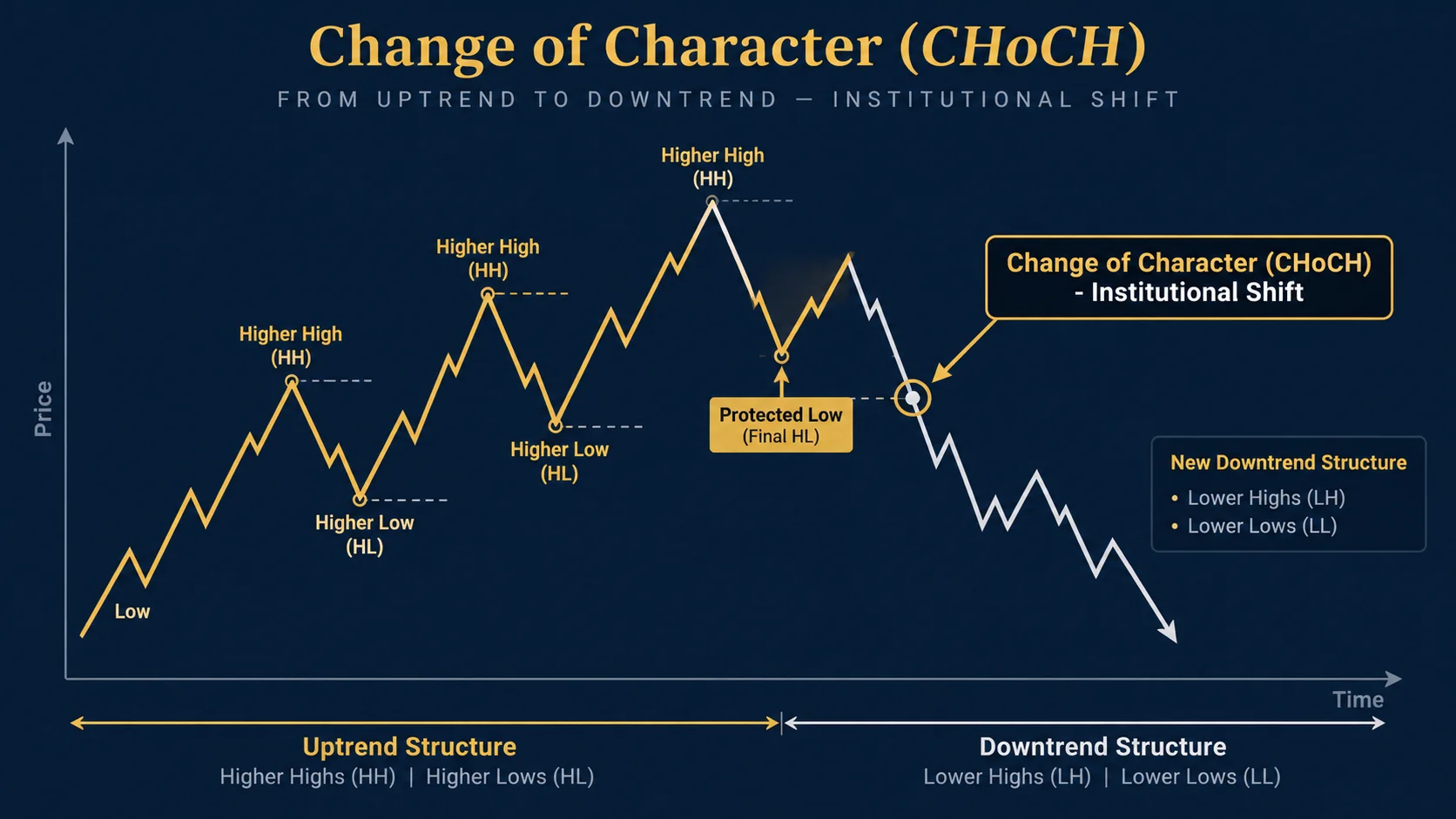
An uptrend is just a series of higher highs and higher lows, and the buyers protect those lows. When price falls and breaks below one of them, the market has changed its character, because it is no longer buying and has started selling. This idea sits inside a bigger picture of how charts are built, and How to Read Forex Market Structure on a Raw Chart lays out that whole picture in one place.
How a Change of Character Actually Works in the Market
It helps to know what is happening behind the screen. When a trend is moving up, it is because there are more buyers than sellers, and the big banks and funds place large buy orders at these "protected lows". As long as those orders are there, the price stays up.
When the big players want to sell, they stop protecting those lows and start selling instead, so the price drops and breaks the low, which tells you the big money has stopped buying. This way of reading price through the eyes of the banks comes from smart money concepts, and What Is Smart Money Concepts in Forex for Beginners explains the full approach for beginners.
Which low breaks matters a lot. In an uptrend, the important low is the one that created the latest higher high. Traders call it the protected low, because buyers had to defend it for the trend to continue, so when price closes below that specific low, the uptrend's promise is broken. Breaking some random small low inside a pullback does not count.
When the protected low gives way, a lot of stop losses are sitting just beneath it, so the break is often quick. That speed is information, not a signal to jump in, because it tells you the buyers are no longer in control but it does not yet tell you the sellers are.
The Big Difference Between CHoCH and BOS
Do not confuse a CHoCH with a Break of Structure, or BOS, because mixing these two up is a fast way to lose money. A BOS happens when the trend keeps going, and a CHoCH happens when the trend breaks. The BOS side of this deserves a proper look on its own, so I wrote What Is BOS in Forex and How Do You Trade It to keep the two ideas clearly separate in your head.
Think of it this way: a BOS is the train staying on the tracks, while a CHoCH is the train pulling into a station, where it might turn around or might just be stopping for a while. If you see a break in the direction of the trend, it is a BOS, and if you see a break against the trend, it is a CHoCH. One confirms the path and the other is a warning. If you want to master these moves, How to Read Forex Market Structure on a Raw Chart explains the whole process so you can finally see the big picture.
There is also a stronger version of the CHoCH, one that comes straight after a sweep of waiting orders with very fast candles. Traders call that a market structure shift, and it is big enough to need its own guide: What Is a Market Structure Shift in Forex and How to Trade It?
Minor vs Major Change of Character
Not every CHoCH carries the same weight. A minor CHoCH happens inside a pullback, on the small swings, and it usually just means the pullback is ending, so very often the main trend carries on. A major CHoCH breaks the protected low or high of the main trend itself, and that is the one that can end a trend. It is a bit like a football team conceding a goal in the first half, which is a warning sign, but nobody knows the result until the final whistle. If you want to understand how the big boys cause these major shifts, What Is Smart Money Concepts in Forex for Beginners explains their footprints perfectly.
The easiest check is the timeframe. A CHoCH on the 5 minute chart, in the middle of a 4 hour uptrend, is almost always minor, while a CHoCH on the 4 hour chart at a key daily level is major. Sorting the main swings from the small ones gets easier with practice, and How to Tell Major vs Minor Swings in Forex Trend Analysis shows how I do it on a real chart.
How to Spot a Valid Change of Character in Forex on Your Charts
Spotting a change of character in forex takes time, and you need a process. First, look at a 4 hour chart and decide whether you think the market will go up or down, which we call your bias. It is like looking at the sky in the morning to see if it might rain later. Setting that bias without forcing it is a skill of its own, and How to Find Daily Bias in Forex Without Forcing Direction is the routine I follow every morning.
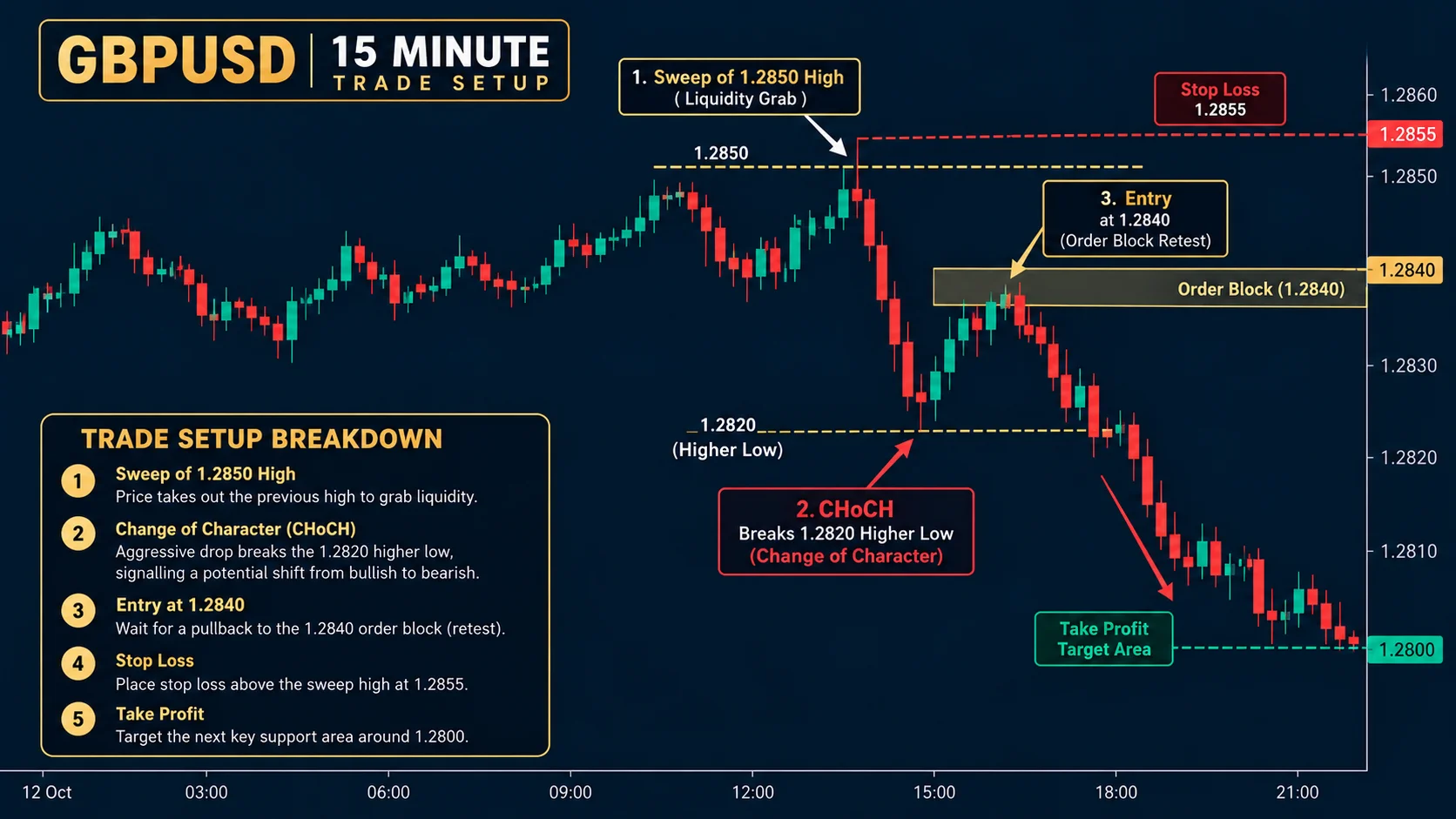
Next, wait for price to reach a key zone where you expect a turn. I look for areas where a lot of people have pending orders, and we call these orders liquidity. Once price reaches that zone, switch to a 15 minute chart and wait for price to close below the last low that made a high. You must see the candle body close below that level, because a wick alone is not enough. Certain candle shapes often show up right at these turning points, and How to Trade Hammer and Shooting Star Candles in Forex teaches you to read two of the most common ones.
GBPUSD was where I first tried this. I used to guess when the market would turn on the 4 hour chart, and because I was always too early I kept losing small amounts of money over and over, which was painful. Once I started waiting for the 15 minute CHoCH, things became much clearer, because I had stopped guessing and was letting the market show its hand first. That is the same advice I would give anyone who is new or wants to improve. Very small charts bring their own false moves, and if the 1-minute chart keeps tricking you, How to Trade Micro Market Structure on Lower Timeframes shows what the real moves look like down there.
What to Do With Your Open Trades After a CHoCH
This is where a change of character is most useful, and almost nobody talks about it. If you are already in a trade with the old trend, a CHoCH against you is your cue to act:
- Stop adding. No new trades in the old direction until structure is clear again.
- Protect what you have. Move your stop to break even, or take part of the profit.
- Mark the new range. Draw a line at the high that started the drop and the low that just broke. Price is now deciding between them.
Many of my best saved trades came from respecting a CHoCH that I did not want to see.
Trade the Confirmation, Not the CHoCH
If you want to trade the new direction, do not sell the moment price breaks the low. Wait for the confirmation ladder instead:
- The CHoCH: price closes below the protected low.
- The failed retest: price pulls back up but fails to make a new high.
- The first BOS in the new direction: price makes a new lower low.
Only after step three is the trend really down, and then I look to sell the next pullback, often from an order block (the last area where big orders were placed before the drop) or a fair value gap, which is a gap the fast drop left behind. Finding these zones on your own chart takes practice, and How to Use Market Structure Entry Signals in Forex walks through how I pick them out.
Let us say you risk 1 percent of your account. On GBPUSD the ladder completes and price pulls back into an order block, so you place a sell order there with your stop just above the failed retest high. If that is a 20 pip stop, you aim for a 60 pip target, which is a 1:3 reward to risk. You will miss the first part of the move this way, and that is the price you pay for trading a trend that has actually changed instead of guessing.
The Common Traps That Catch Beginner Traders
The biggest trap is trading against the main trend. If the daily chart says the market is going up, a 5 minute CHoCH to the downside is likely a trap, and it is probably just a small dip before price goes higher, so only trade with the main trend. The line between a small dip and a real turn is where most people get caught, and How to Tell When a Pullback Becomes a Reversal in Forex goes through the checks that help me tell them apart.
Also, avoid trading at night when the markets are quiet. There is less money moving, so price moves in strange, fake patterns. Stick to the busy times when London or New York is open, because signals outside those hours tend to make you lose and trade without any consistency.
Where To Read Next
If you want to keep learning about how the market is built, check out our other guides:
- How to Read Forex Market Structure on a Raw Chart
- How to Use Market Structure Entry Signals in Forex
- What Is a Market Structure Shift in Forex and How to Trade It?
- How to Find Daily Bias in Forex Without Forcing Direction
- How to Trade Hammer and Shooting Star Candles in Forex
- How Much Time Do You Need Every Day to Trade Forex?
Frequently Asked Questions
What is a change of character in forex?
It is the first break against the trend, when price closes below the last protected low in an uptrend, or above the last protected high in a downtrend. It is an early warning that the trend may be ending.
Should I enter a trade as soon as I see a change of character?
Usually not. Wait for a failed retest and a first break of structure in the new direction, then enter on a pullback, because entering on the CHoCH itself often catches a pullback instead of a reversal.
What should I do with my open trade after a change of character?
Stop adding in the old direction, protect the trade with a break even stop or partial profit, and mark the new range between the last high and the broken low.
Can a change of character fail?
Yes, and quite often. Minor CHoCHs inside a pullback fail all the time and the trend carries on, which is why a CHoCH is a warning first and a trade only after confirmation.
What is the best timeframe to trade CHoCH?
Use the 4 hour chart to judge the main trend and the 15 minute chart to watch for the CHoCH at a key level. A CHoCH on a higher timeframe carries more weight.
If this helped you, send it to a friend who is learning to trade.