There is a moment some traders only live through once, if they are lucky, when the trading platform starts closing positions on its own and the account balance keeps dropping while you sit there and watch. It happens because the money left in the account is no longer enough to hold up the trades you have open, and by then the decisions are no longer yours to make.
That is where a margin call in forex leads if nothing changes, and the good news is that it is almost completely avoidable. Below I explain in plain numbers what margin is, what the margin call and stop out levels mean, and the few habits that keep your account well away from both of them.
What Happens Inside Your Broker's Server When You Lose Money
A lot of people, traders in particular, think the money they deposited is the only thing protecting their trades. But when you open a trade, you use a small amount of money to control a much bigger position, and that borrowed size is called leverage. If you put in 100 dollars and the broker lets you control 10,000 dollars, you are using leverage. The idea of borrowing power is easier to see with a few examples in front of you, and What Is Leverage in Forex Trading and How Does It Work? gives you those in simple words.
The broker takes a risk on you when it lends you that size. To protect itself, it watches two numbers, margin and equity. Equity is the money you would have left if you closed all your trades right now. Used margin is the deposit the broker locks away to keep your trades open.
Think of used margin as the security deposit you pay when you rent a car. As your trades lose money, your equity drops, and the moment your equity falls to a certain percentage of your used margin, the broker's system wakes up. That percentage is the trigger for a margin call. The broker does not care about your feelings or your chart patterns, it only cares about protecting its own money. Once this part makes sense, the natural next question is how so little money can hold such large positions, and that is exactly what What Is Leverage in Forex Trading and How Does It Work? sets out to answer.
I have a friend who thought he could "wait out" a bad trade. He did not realise the broker was watching his equity like a hawk, so when the market moved against him, he did not have enough cash to cover the broker's risk and he lost his entire account in a few moments. Today that same person is one of the most experienced traders I know, but back then those moments were his school of hard knocks. You get knocked down and you get up again, because life is a process of lessons, the hard ones included, and trading the forex market is the same.
The Difference Between Margin Level, Margin Call, and Stop Out
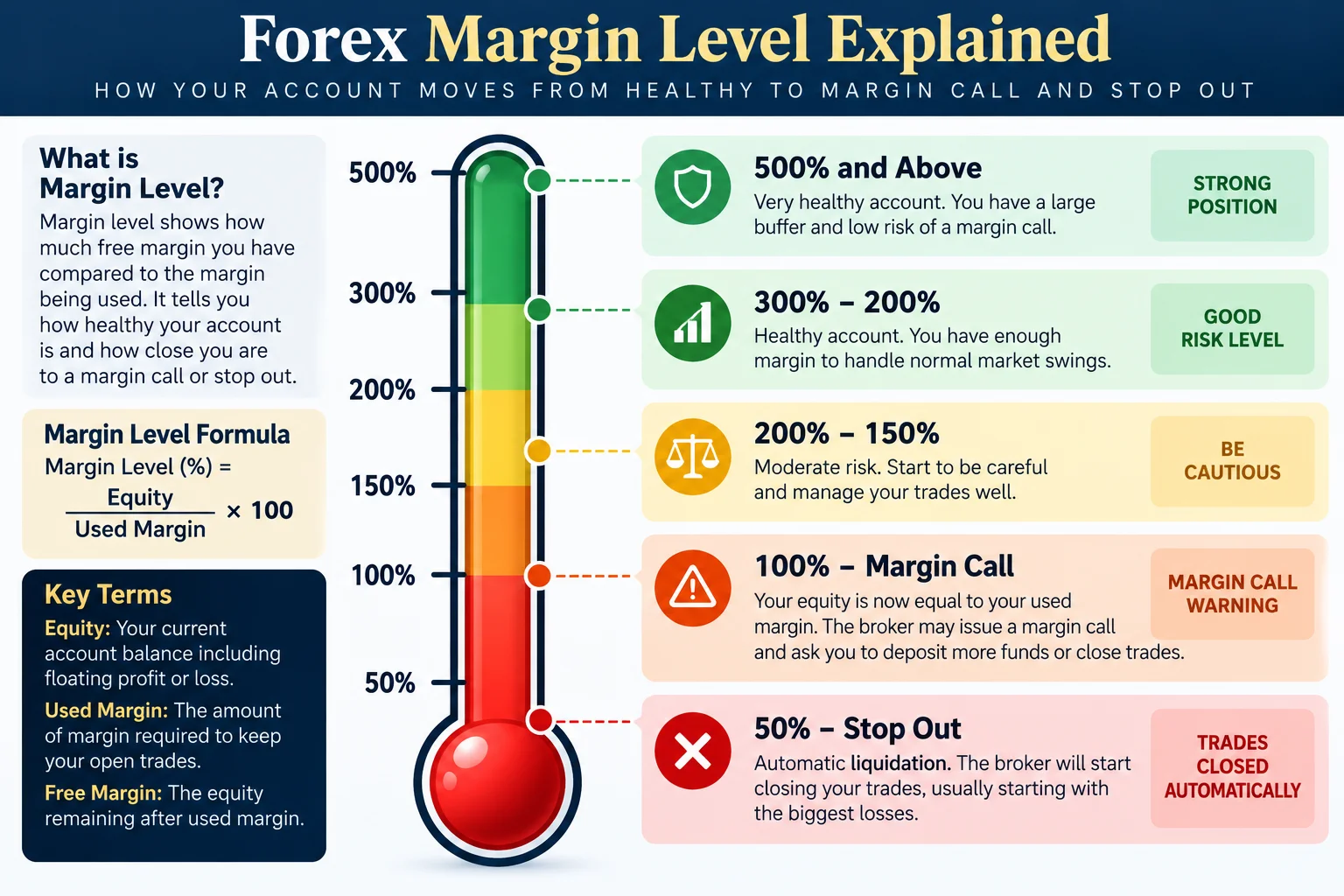
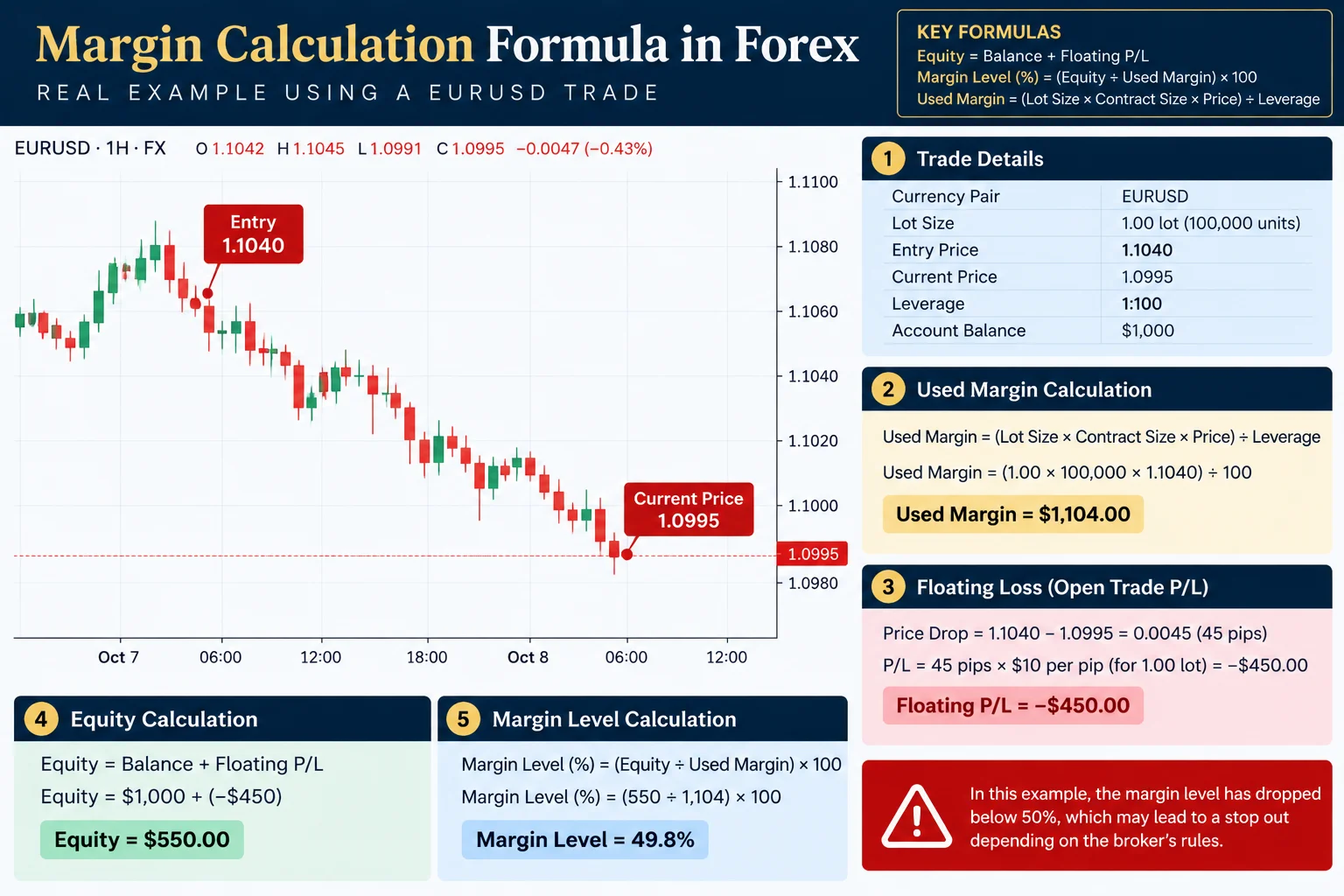
Platforms use three terms that sound alike but mean different things. Margin level is a score, and you get it by dividing your equity by your used margin and then multiplying by 100. If your equity is 1,000 dollars and your used margin is 200 dollars, your margin level is 500 percent, which is healthy. Words like equity and margin pile up fast when you are new, so if any of them still feel slippery, have a look at What Do Forex Terms Mean for Beginners? before you go on.
As you lose money, that 500 percent starts to drop. When it reaches a certain level, maybe 100 percent, you get a margin call. This is just an alert that tells you your account is weak, and that you should either add more money or close some trades. It is a warning, not a punishment. IG's trading glossary describes a margin call in the same way, as a notice to add funds or reduce your trades.
If you ignore it, the number keeps falling. When it reaches the stop out level, for example 50 percent, the broker takes over and closes your biggest losing trade. If that does not help, it closes the next one, and it keeps going until your account is safe again. Think of a fishing boat taking on water in rough waves, where the crew starts throwing the heaviest load over the side first until the boat floats again. In Europe this is a rule: the markets regulator requires brokers to start closing a retail client's positions when margin falls to 50% of the required minimum, and gives retail clients negative balance protection, so they cannot lose more than they deposited (ESMA).
Why Small Accounts Are Most at Risk of Sudden Closing
If you trade with a small balance, managing your margin is everything. A trader with 10,000 dollars can handle a small loss easily, but a trader with 100 dollars cannot. When your account is small, every little move against you takes a big bite out of your money, which is why you need to understand how the risk maths works before you start. For anyone beginning with a small amount, How to Start Forex Trading With $100: A Beginner Guide shows how to set things up so your first account is not lost in the first week. If you want to master these basics properly, How to Start Forex Trading With $100 Step by Step shows you exactly how to grow your account safely.
High leverage looks like power to most beginners, but that is an illusion, and a dangerous one. I once opened a position on GBPUSD that was far too large for my tiny account, expecting the market to wiggle a bit and then bounce back. Instead a sudden news spike pushed price against me and my margin level fell straight down, so before I could even click to close the trade, the broker had closed everything because I had used too much leverage. I want you to start from a better place, with more knowledge and understanding than I had when I first began. Pairs like GBPUSD move in their own way, so before you trade them again, read How Do Currency Pairs Work in Forex Trading? and get clear on what you are actually buying and selling.
How to Calculate Your Danger Zone Before You Place a Trade
Never wait for the broker to warn you, because by then it is late. Work out your risk before you press buy or sell. Let us use a real example where you have 500 dollars and you decide to risk 2 percent of your account, which is 10 dollars. If you trade 0.50 lots, a move of just 20 pips will wipe out a huge chunk of your equity. I always tell my students that you cannot manage your risk properly until the size of your trade makes sense to you, and What Is a Lot Size in Forex Trading? is where that starts.
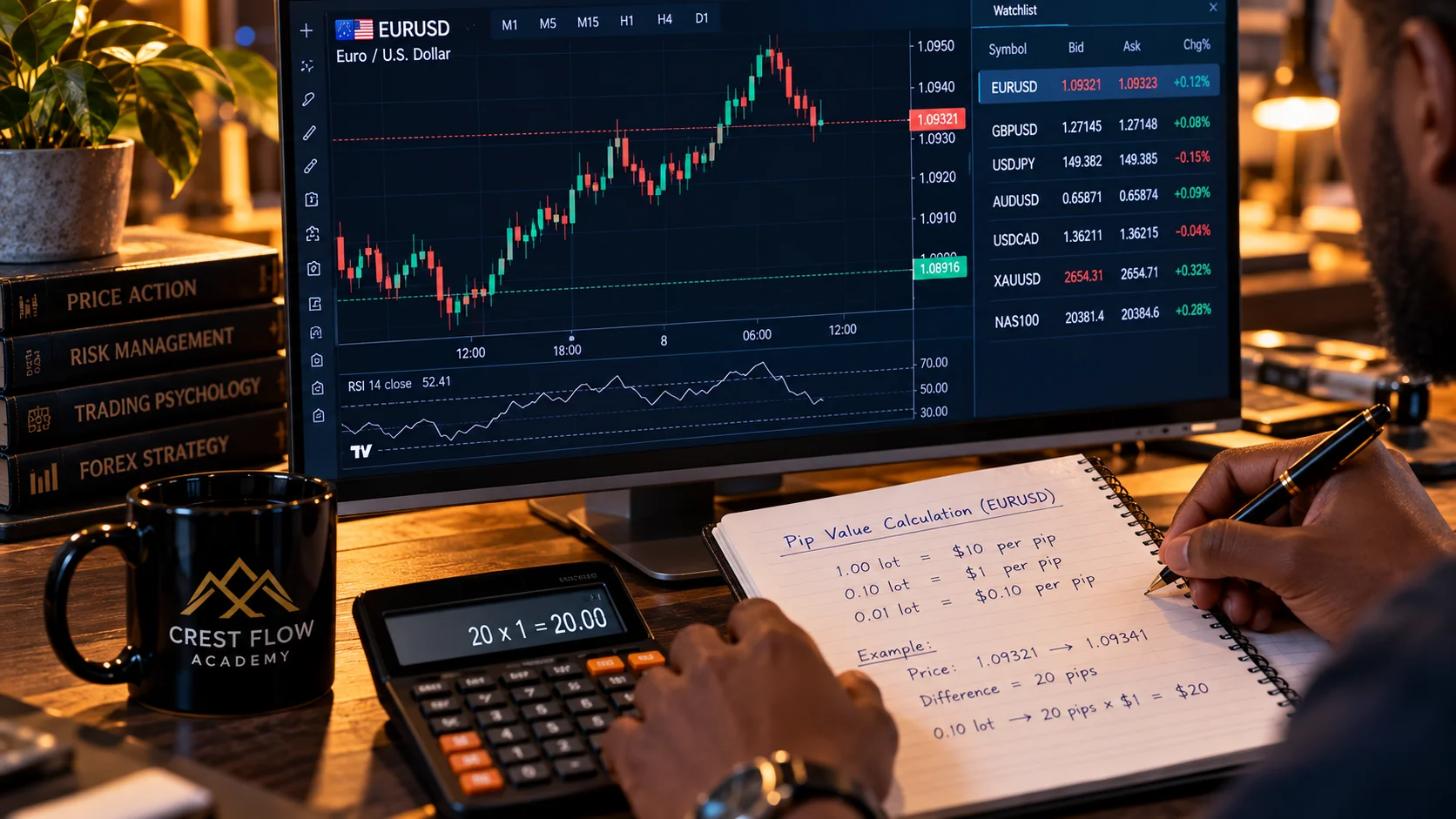
To find your danger zone, look at your margin requirement. If one standard lot needs 1,000 dollars of margin, a micro lot of 0.01 needs only 10 dollars. If your used margin is 100 dollars and your equity drops to 100 dollars, your margin level is 100 percent, and you are standing right on the edge of the cliff. Every one of those small price moves is counted in pips, so it is worth reading What Is a Pip in Forex and How Do You Calculate It to see how they turn into dollars, because that is what decides whether your margin stays safe or disappears.
Margin Level = (Equity / Used Margin) * 100
Equity = Balance + Open Profit or Loss
Used Margin = Money locked by open trades
If that number drops toward 200 percent, your trade is simply too big, and there is no argument about it.
Practical Steps to Make Sure You Never See a Margin Call
Avoiding a margin call is simple maths. Start by asking your broker to lower your leverage, so if they offer 1:500, ask for 1:30, which makes it hard to open a trade that is too big. I did this years ago and it saved me from my own bad impulses, and some brokers also let you change your leverage yourself in your account settings. The broker you pick decides a lot of these settings for you, so before you sign up anywhere, go through How to Choose a Forex Broker for Beginners and know what to look for.
Second, never risk more than 1 or 2 percent of your account on one trade. If you have 1,000 dollars, do not lose more than 10 or 20 dollars on a single idea. Size your trade based on how far away your stop-loss is, and a stop-loss is simply a price where you agree to get out if you are wrong.
Third, never add money to a losing trade. Some people do this to "average down" their price, but it only eats up your margin faster, and it is the quickest way to lose your entire account.
The Information Alone Won't Save Your Account
Reading this is the easy part, and changing your habits is the hard part. Most traders will read it and still use oversized positions tomorrow, because they want to get rich fast. But the market is not a casino, and if you treat it like one, it will take your money. I am not your financial adviser; this is only what worked for me. If you want to build a lasting career instead of a lucky week, follow a proper path of lessons, and the one I trust is How to Learn Forex Trading Step by Step for Beginners.
Where To Read Next
Keep building your foundational knowledge with these related guides:
- How to Start Forex Trading With $100 Step by Step
- How to Learn Forex Trading Step by Step for Beginners
- What Is Leverage in Forex Trading and How Does It Work?
- Is Forex Demo Trading Worth It for Beginner Traders?
- The Best Forex Brokers in 2026 and Which One to Use for What
- How to Use Smart Money Concepts for Retail Trading Strategy
Frequently Asked Questions
What is a margin call in forex trading?
It is an automatic alert from your broker telling you that your account equity has fallen below the level needed to keep your trades open.
Why do my trades get automatically closed by the broker?
This happens when you hit the stop out level. The broker closes your trades so that your account balance does not fall into debt.
How do I calculate margin level on a small forex account?
Divide your total equity by your used margin, then multiply by 100. This percentage tells you how much breathing room your account has left.
How can I avoid getting a margin call as a beginner?
Lower your leverage and limit your risk to 1 or 2 percent of your account per trade. Always use a stop-loss so your exit point is decided before you enter.
Is a margin call the same thing as a stop out?
No, they are different. A margin call is a warning notice, while a stop out is the final step where the broker closes your trades.
Can my forex account balance go below zero?
Most trustworthy brokers give you negative balance protection to stop this from happening. Even so, you should still use small position sizes so your account stays safe.
If this helped you, send it to a friend who is learning to trade.