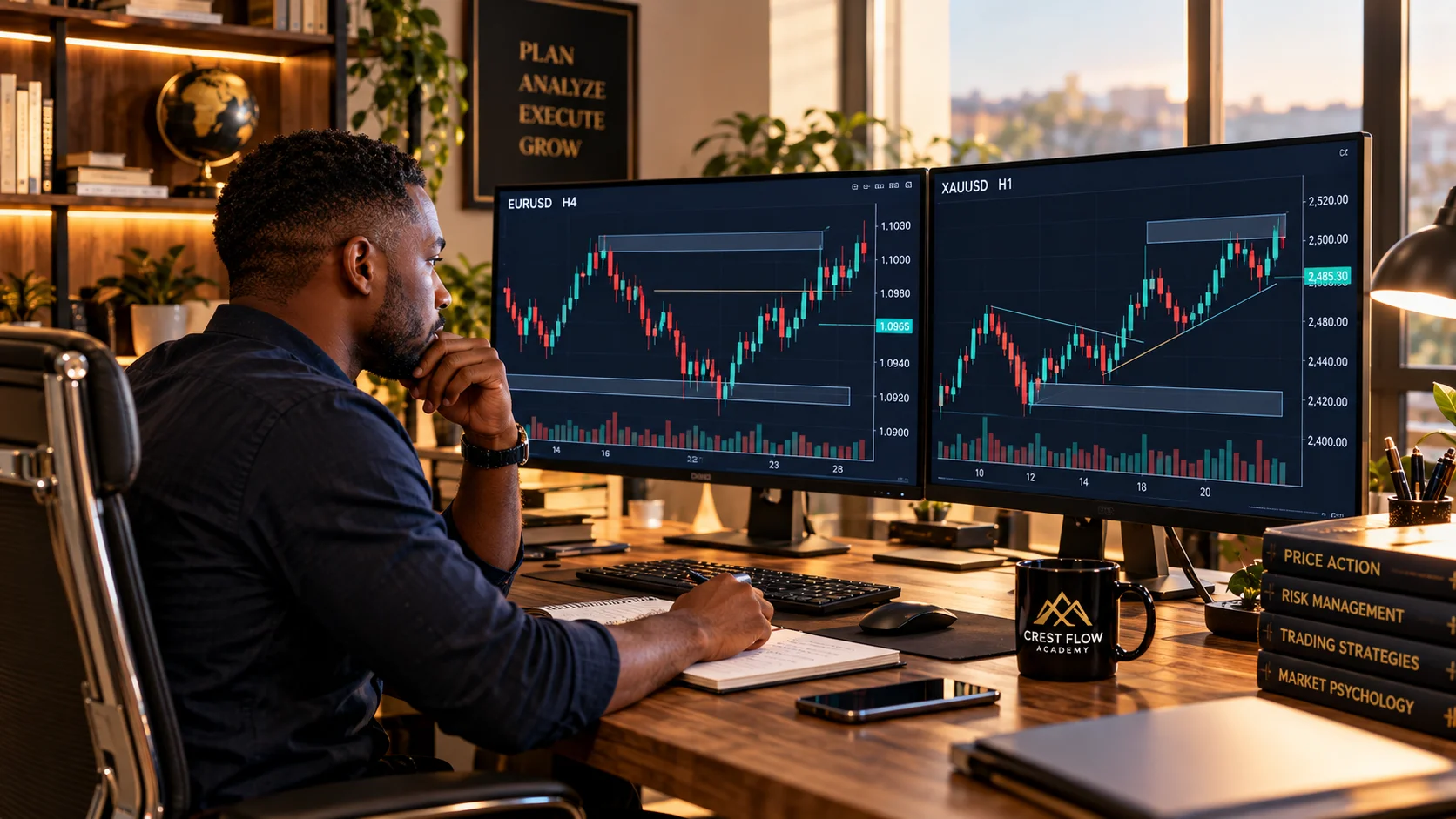
Doubling a $50,000 demo account in a week feels wonderful, and yet it tells you surprisingly little about how you will trade when the money is your own. Many traders find that the first time a small live trade goes against them, the calm they had on demo disappears, and they close the position early or move their stop in a way they never did with practice money.
So is forex demo trading worth it for beginner traders? I believe it is, but only if you use it for the right job. A demo account is excellent for learning your platform, testing a set of rules and practising how to place orders, but it does a poor job of preparing you for the feelings that come with risking real money. Below I explain how I would use demo trading today, and when I would move across to a small live account.
How Demo Trading Actually Works
I want you to understand what happens behind the scenes first. In a demo account you are not trading with the real market at all, you are trading against your broker's software. Brokers also handle real orders and fees in very different ways, and that is one of the reasons I would read How to Choose a Forex Broker for Beginners before you pick where to open your account.
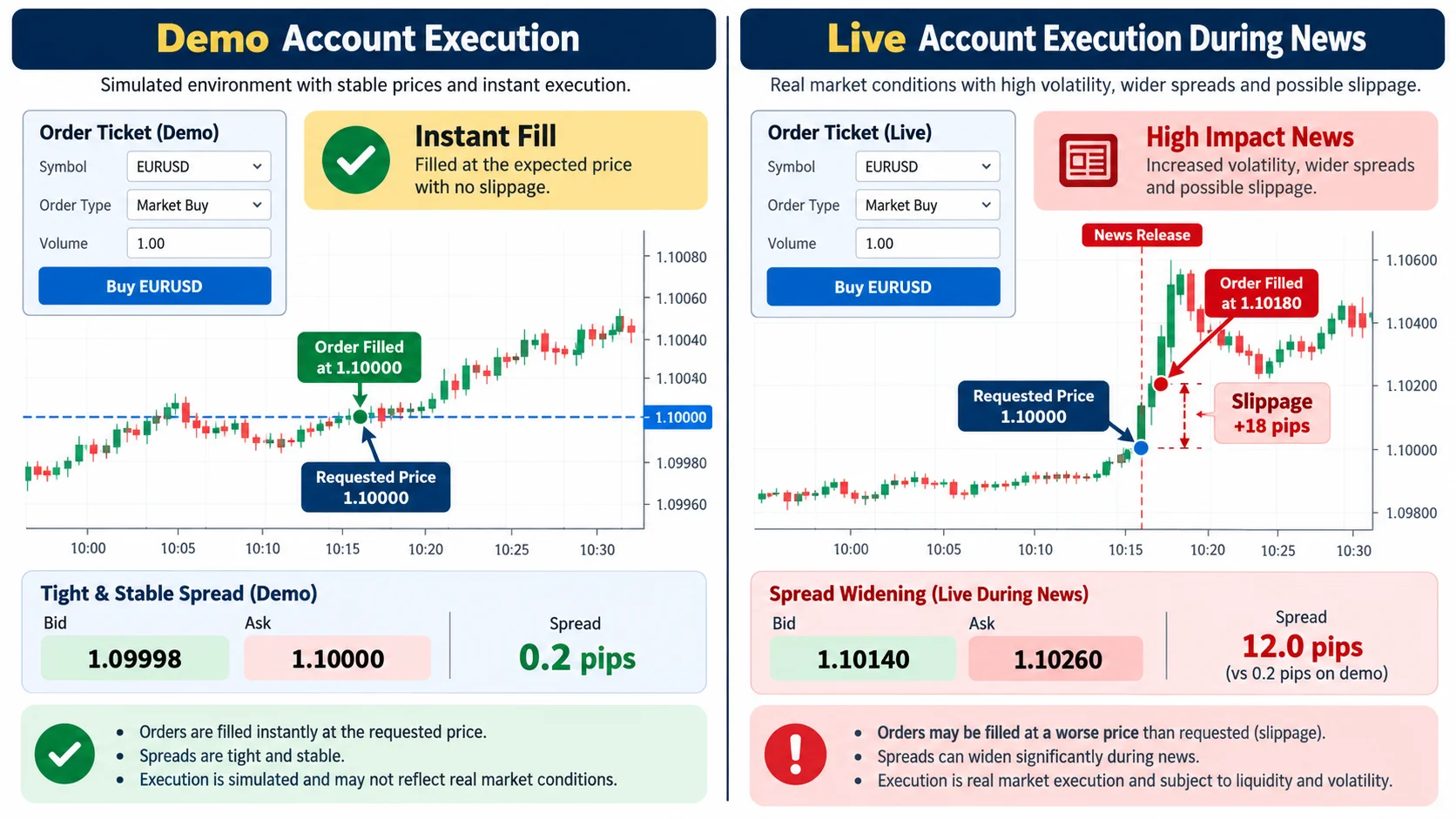
Because the money is not real, the computer fills your order instantly. In the real world, someone has to be willing to take the other side of your trade, and that supply of willing buyers and sellers is called liquidity. When the market is moving very fast, your order might not get filled at the price you wanted, because the price jumps right over your number, and this is called slippage.
Imagine you want to buy at 1.0500 and you click buy. If there is nobody selling at that price, the market gives you 1.0505 instead, and that five-pip difference is slippage. Demo accounts do not show this well, because they make every trade look perfect. Small gaps like that add up over many trades, so it pays to learn What Is a Pip in Forex and How Do You Calculate It and know exactly what each one is costing you.
In my experience, demo accounts often give a false sense of success. The moment real money is involved you will hesitate, and you will either wait too long to cut a losing trade or grab a small profit far too soon. A demo account cannot teach you how to handle that fear. Australia's financial regulator notes that most retail investors find it hard to make money from leveraged forex trading over the long term, which is why the move from demo to live deserves respect (ASIC's Moneysmart).
The Real Value of a Paper Trading Account
None of this means demo trading is useless, because it is simply a tool with one main job. Think of it like a flight simulator, where you learn where the buttons are and how the controls respond before you ever sit in a real plane. When the buttons stop feeling strange, the next step is a proper learning plan, and How to Learn Forex Trading Step by Step for Beginners sets out the order I would follow.
You use a demo account to learn your trading platform and to practise setting a stop loss. A stop loss is an order that tells your broker to close your trade automatically if the price moves against you by a set amount, and it is what stops one bad trade from wiping out your whole account.
Then came my first move to a live account. After months on demo feeling like a professional, I was trading EURUSD and thought I knew exactly what to do, yet the moment I placed a tiny trade with my own cash, my heart started racing. Demo had taught me how to place the trade, but it could not teach me the calm I needed or how to control my emotions. Before you risk your money, it helps to understand the push and pull between two economies that sits behind every pair, and How Do Currency Pairs Work in Forex Trading? is where I explain those basics.
You should never use a demo account to test whether your strategy makes money over the long term. You only really know if a strategy works when you feel the sting of a real loss.
Where Demo Trading Creates Dangerous Habits
If you stay on a demo account for too long, you will get lazy with risk. Risk management simply means deciding how much money you are willing to lose on a trade so that you can stay in the game. You can better protect your capital by reading What Is the Difference Between Margin and Equity in Forex? so you understand how your account balance is affected.
With a fifty thousand dollar pretend balance, losing five hundred dollars feels like nothing, so you just keep on trading. But if you lose five hundred dollars of your own savings, you will feel sick. It is like a practice test at school that does not count towards your grade, where a careless answer costs you nothing, so you never learn to slow down and check your work. The demo account lets you make mistakes without feeling any pain, and that is how bad habits are built.
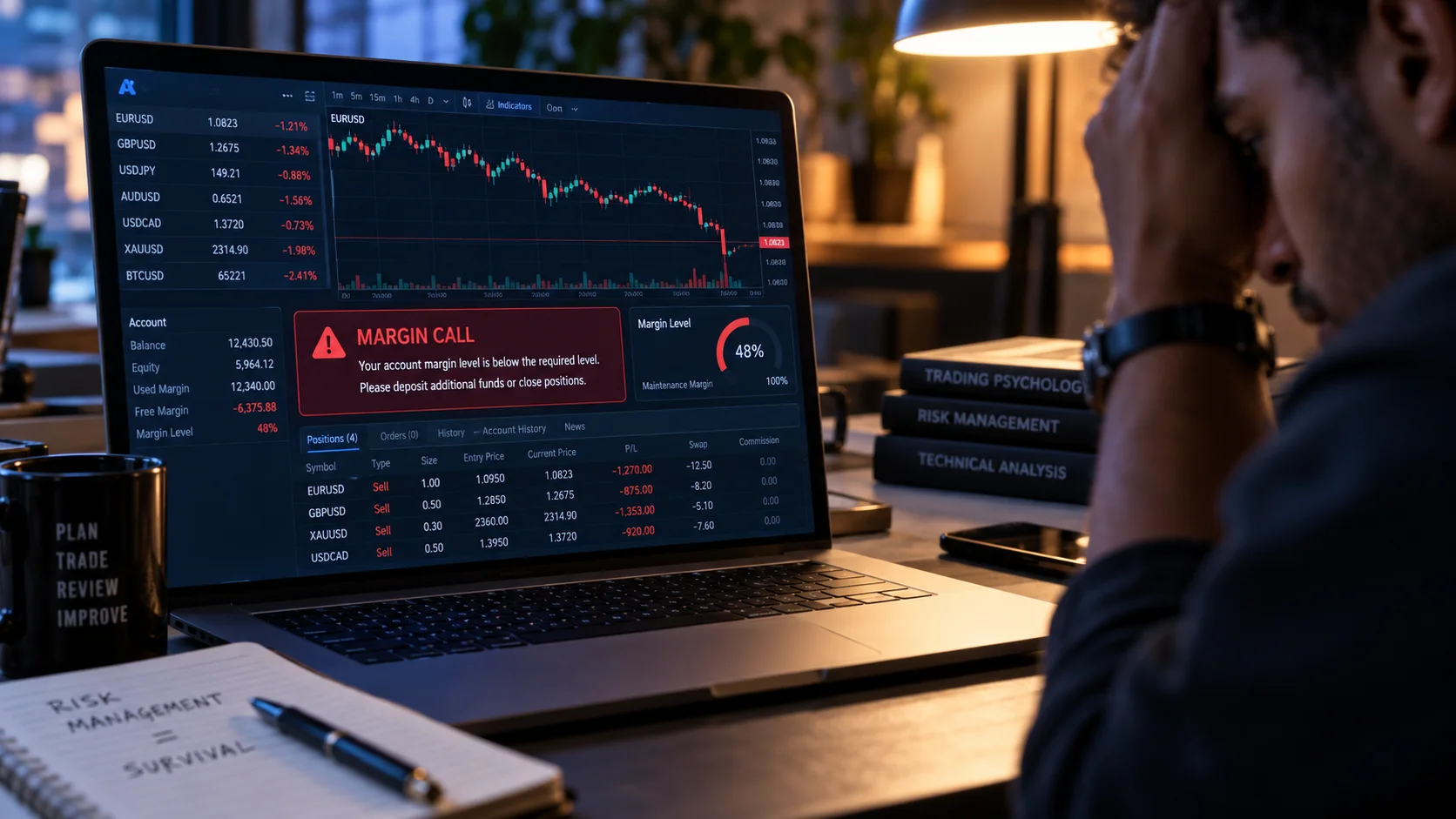
On demo, you might hold a bad trade for weeks until it turns into a profit. In a live account, if you hold a bad trade for too long, you will run out of money, and the broker will warn you with a margin call and then close your trade for you, which is called a stop out. Much of that danger comes from borrowed money, and What Is Leverage in Forex Trading and How Does It Work? shows how a tiny deposit can end up controlling a very large position.
The Bridge: How to Use a Demo Account Correctly
You can use a demo account well if you follow a few rules. First, set your pretend balance to match the amount of real money you plan to use, so if you have two hundred dollars to trade, set your demo balance to two hundred dollars. Do not practise with a huge amount when you only have a small one. Choosing that number is harder than it sounds, and How Much Money Do You Need to Start Trading Forex gives you a realistic starting point.
Second, treat every pretend trade as if it were your own cash. Write down why you are entering each trade, and if you break your own rules, count it as a failure even when the trade wins.
Open a demo account with the same amount of money you will use live.
Test any new idea on it for two to four weeks.
Focus only on learning the buttons and the software.
Move to a live micro account as soon as you stop making technical errors.
The goal is to stop leaning on a feeling of safety that is not real, and to move your thinking into the real world as early as you can.
Why Small Live Accounts Beat Long Demo Stints
At some point demo trading stops helping you and starts to hold you back, because you cannot learn to handle fear in a sandbox. Before your real savings are on the line, make sure you have read What Is Margin Call in Forex and How to Avoid It, since a margin call is the first nasty surprise many new live traders meet.
I suggest moving to a live account with a very small amount of money as soon as you can, and trading in tiny sizes. If one pip equals ten cents, you will feel the loss, but it will not break you, and that is how you learn to control your emotions. When you are ready to take that step, How to Start Forex Trading With $100: A Beginner Guide walks you through setting up a small account you can manage. If you want to see exactly how to manage your risk with a small deposit, How to Start Forex Trading With $100 Step by Step shows you the ropes.
There is an old saying that in theory there is no difference between theory and practice, but in practice there is. The theory looks perfect on a demo chart, while the practice of using real money is where you actually learn to trade.
Where To Read Next
If you want to keep learning, these are the ones I would read next.
- How to Start Forex Trading With $100 Step by Step
- How to Learn Forex Trading Step by Step for Beginners
- What Is Leverage in Forex Trading and How Does It Work?
- What Is Margin Call in Forex and How to Avoid It
- What Is the Difference Between Margin and Equity in Forex?
- The Best Forex Brokers in 2026 and Which One to Use for What
Frequently Asked Questions
Is forex demo trading worth it for beginners?
It is useful for a short time while you learn your trading software. Avoid staying on it for too long, or you will start building bad habits.
How long should a beginner use a demo account?
Two to four weeks is enough. Spending longer often turns the whole thing into a game rather than a way of learning.
Why do I win on demo but lose on live accounts?
Demo trading has none of the pressure of real risk. Real money brings fear, and fear often leads to mistakes like closing winning trades too early.
Should my demo account balance match my real account?
Yes, it should. A large pretend balance gives you unrealistic expectations and encourages risky habits you cannot afford with your actual money.
Can you make real money from a forex demo account?
No, you cannot, because demo profits only exist on the screen and can never be withdrawn.
If this helped you, send it to a friend who is learning to trade.