The Power of the Marubozu Candle
Most of the time, traders spend hours staring at wicks. They worry about the tiny shadows that poke out of the top or bottom of a candle. But sometimes, a candle appears that has no wicks at all.
It is just a big, solid block of colour. This is the marubozu candle in forex. It looks simple, but it is actually the loudest message the market can send you. It tells you that one side is in total control.
I remember back then when i started, I used to ignore these big candles because they looked too simple. I thought I needed complex indicators to tell me what to do. But I was wrong.
If you want to understand the market, you must first learn the basics of reading candlestick shapes. A marubozu tells you exactly who is winning the war right now. It is pure, raw strength.
You see, most traders try to overcomplicate things. They look for secret patterns that do not exist. But a marubozu is plain. It is honest. It tells you that sellers or buyers did not hesitate for even a single second. When you see this, you stop guessing. You start watching.
What a Marubozu Truly Means
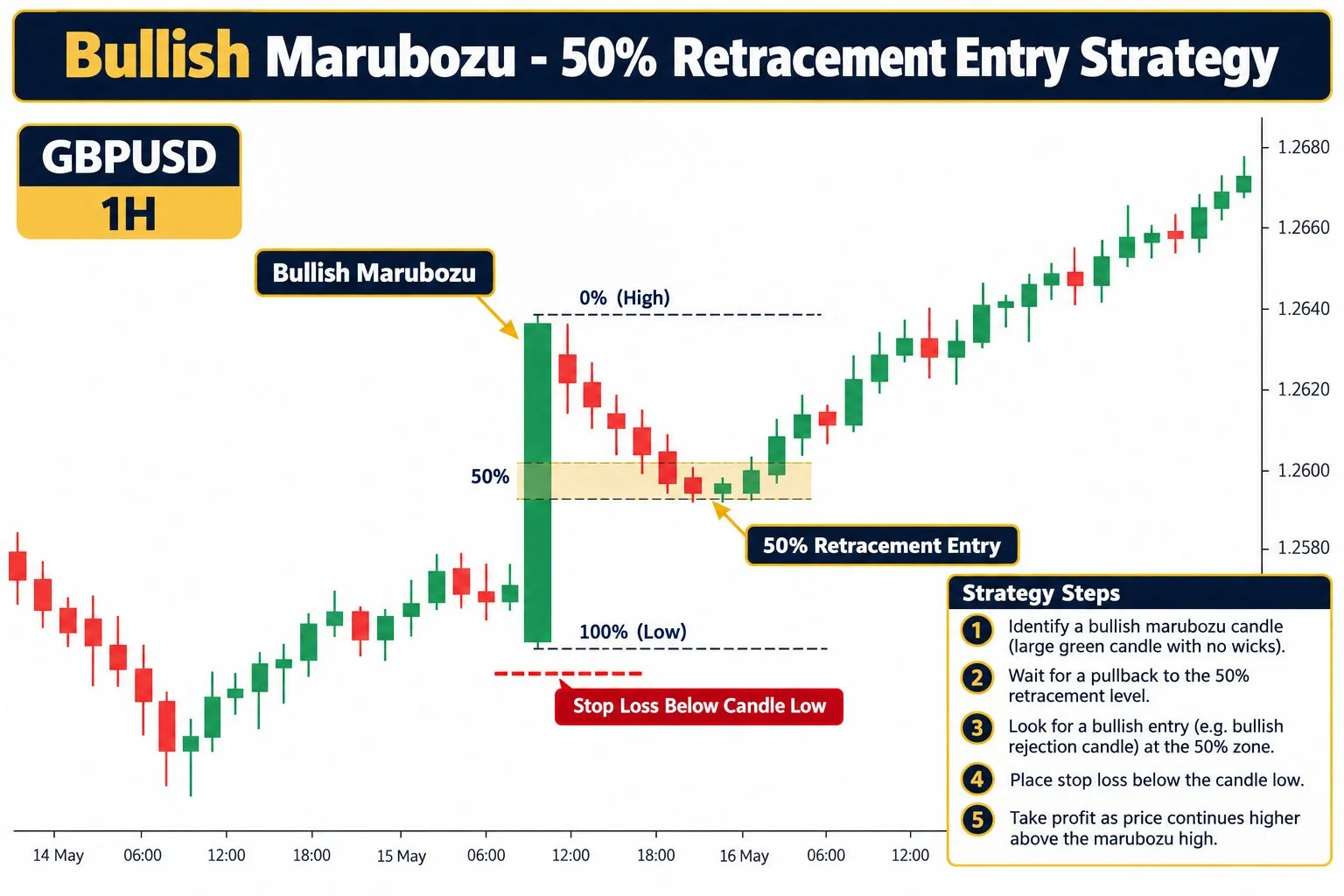
Think of a busy market stall where a seller has a crowd fighting to buy his goods. The price keeps rising from the moment the shop opens until it closes. There is no time for the price to drop even a little bit.That is a marubozu. It is a Japanese word that means "shaved head." It shows that the candle has been shaved of its wicks.
Under the hood, a marubozu happens because one side, either the buyers or the sellers, is much stronger than the other. There is no hesitation. If it is a green marubozu, the buyers are so hungry that they buy every single offer available.
They do not even let the price dip for a second. This is important for your money because it shows you where the big money is pushing. You do not want to fight that kind of force. If you are ever unsure about the right size for your trade, remember that a marubozu confirms the direction, not your position size.
Most beginners think the market is random. They think it moves because of news or magic. But the market moves because of people.
A marubozu is a footprint left by big players. When you see one, you know the big players have arrived. They are not messing around. They have a clear direction in mind.
Why Chasing the Candle Is a Mistake
I remember my early days. I saw a huge, solid green candle on my screen. I felt like if I did not click buy right then, I would lose my chance to make money. That state of thinking is called FOMO or fear of missing out, and it is deadly.
So, I jumped in at the very top. What happened? The market immediately moved against me. It was like the market was just waiting for me to buy so it could take my money.
This is the biggest mistake beginners make. They think a big candle is an invitation to buy at the top. But in reality, a massive move is often already over by the time the candle finishes.
You are buying when the big fish are likely taking their profits. It is like trying to jump onto a moving bus that is already speeding away. Instead, you have to wait for the bus to slow down. If you do not have a plan for where the trend might change, you are just gambling.
If you see a giant candle and you are not already in the trade, stop. Do not click anything. You are already late to the party.
If you jump in now, you are just providing liquidity for someone else to close their position. I learnt this the in the most hard way. I lost many both big and small accounts alike by by chasing candles. I thought I was catching a trend, but I was just catching a trap.
How to Trade the Pullback
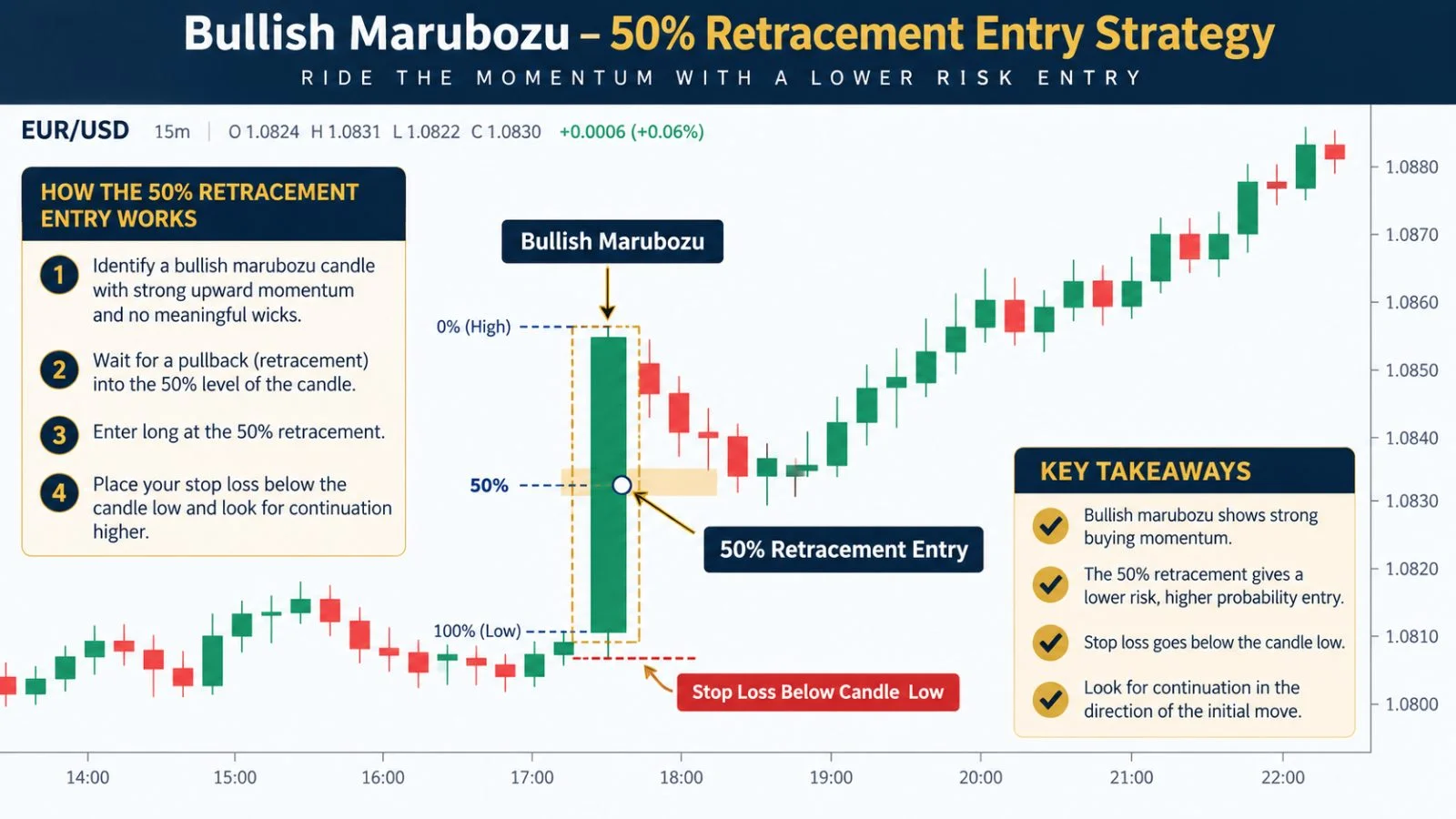
Instead of buying the top, I wait. I look for the price to breathe. This is called a pullback. Think of it like a rubber band. If you pull it really hard, it has to snap back a little before it can go further. I wait for the price to drop back into the body of that big marubozu. Often, the middle of that candle acts like a magnet.
Let us look at an example. Imagine you see a 50 pip green marubozu on EUR/USD. Instead of buying at the top, you wait.
You place a buy order at the middle of that candle. If your entry is at 1.0850, you might put your stop loss at 1.0820, just below the bottom of the candle. This gives you a clear, logical place to exit if you are wrong. It is much better than buying at 1.0875 and having nowhere to hide your stop loss.
By waiting for the pullback, you are managing your risk properly from the start. You are not just hoping the price goes up. You have a plan.
If the price goes below the low of the marubozu, your plan failed. You take a small loss and move on. That is how you stay in the game for the long run. Even when you are looking for entry signals, always remember that no pattern works every single time.
The Importance of Context
Even the best patterns fail if you do not look at why patterns fail without a clear story. A marubozu in the middle of nowhere is just noise. You need to see it happen at a place that matters. For me, I only care about these candles when they break a level that has held price for a long time.
Think of it like a wall. If the price has been bumping against a wall and failing to pass for days, a big marubozu that smashes through that wall is very meaningful. It shows the sellers have finally given up.
They are now trapped on the wrong side of the move. When they realise they are losing, they have to buy back their positions. This adds more fuel to the fire and helps your trade move in your direction.
I always tell my students: context is king. If you see a marubozu, ask yourself what is on the left side of the screen. Did it break a support level?
Did it break a resistance level? If the answer is no, it is just a random candle. Ignore it. Save your money for the setups that actually have a story behind them.
Spotting the Fake Signals
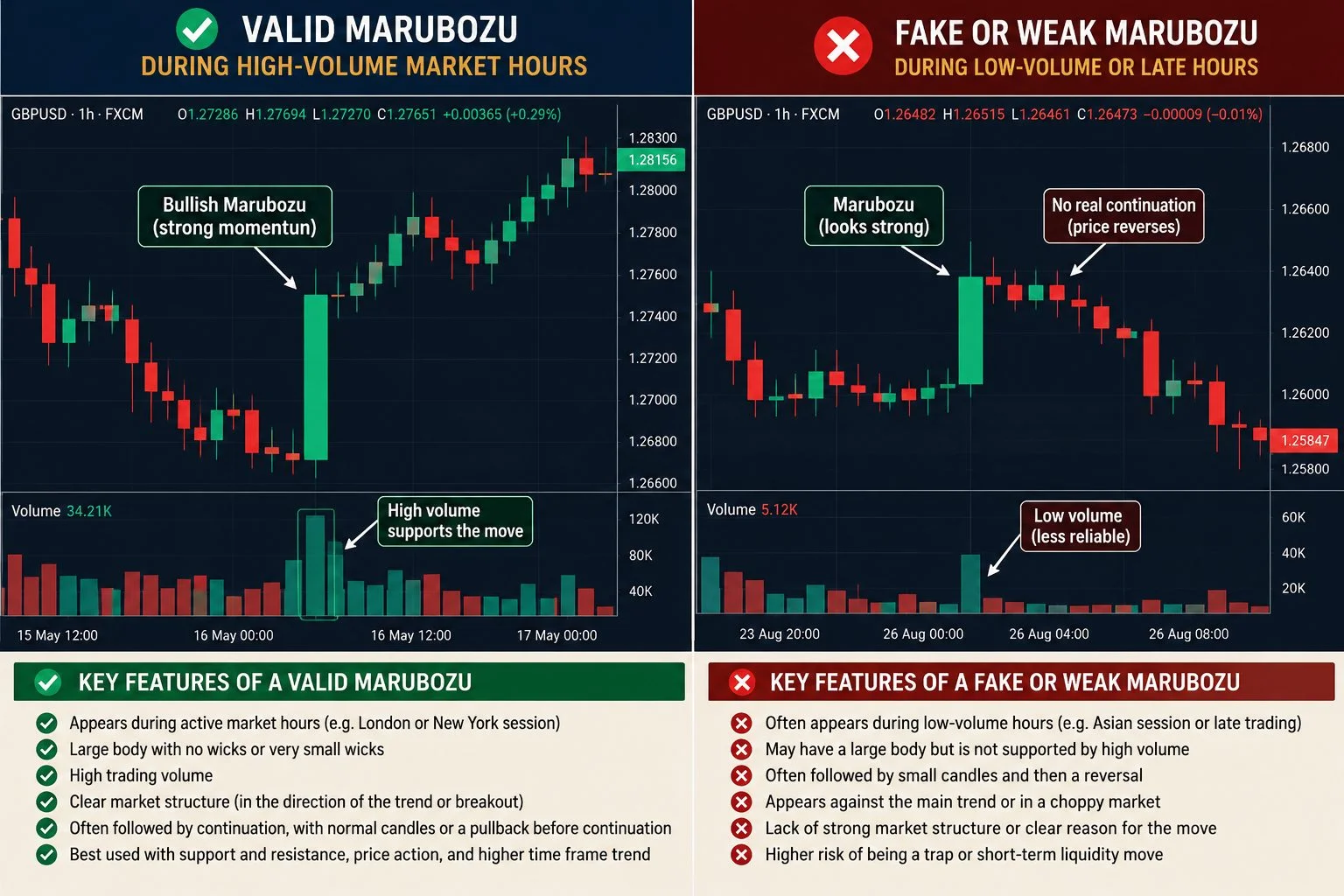
Honestly speaking, not every big candle is a real marubozu. Sometimes, the market is just thin. This happens often when the big financial centres are closed, like during the late hours of the Asian session. If there is nobody trading, it only takes a small, silly order to move the price a long way.
If you see a giant candle when the market is quiet, be very careful. It is usually a fake. It is not the big money showing strength; it is just a lack of liquidity.
I used to trade these quiet breakouts and I got stopped out every single time. Now, I only trust a marubozu that prints during the busy London or New York hours. That is when the real players are at their desks.
You can also look at the volume if your platform allows it. A real move has real volume behind it. If the candle is huge but the volume is tiny, stay away.
It is just a fake move designed to trick retail traders. I have seen many traders lose their accounts because they trusted a candle that had no volume behind it. Do not be that person. If you want to avoid these traps, you must learn where liquidity sits on your chart.
Why Psychology Matters
Trading is not just about charts. It is about your head. When a marubozu appears, your brain will scream at you to buy. It will tell you that you are missing out on the biggest trade of your life. This is why you must control your emotions. FOMO, or the fear of missing out, is the biggest enemy of a trader.
I have felt that fear many times. My heart would race, and my hands would shake. I felt like I had to act immediately.
But the best traders are calm. They know that the market will always give another chance. If you miss a marubozu, it is fine. There will be another one tomorrow or next week.
The moment you accept that you do not need every trade, you become dangerous. You stop chasing. You start waiting for the perfect moment.
That is when you stop losing money and start building your account. It took me years to realise this, but I hope you learn it much faster than I did.
The Role of Timeframes
One question I get often is which timeframe is best for a marubozu. I believe the higher the timeframe, the stronger the signal. A marubozu on the 4 hour chart is much more important than one on the 5 minute chart. The 4 hour candle represents four hours of struggle between buyers and sellers.
On the 5 minute chart, a big candle could just be one big order hitting the market. It does not mean the trend is changing. If you are a beginner, stick to the 1 hour chart or the 4 hour chart.
These timeframes filter out a lot of the useless noise. They show you the real direction of the market. Remember that you do not need to trade every timeframe. Pick one and get to know it well. If you choose the 1 hour chart, stick to it.
Learn how the market acts on that chart. Become an expert at watching how price moves on your chosen timeframe. That is how you gain an edge.
What You Can Do Today
You do not need to trade this today. Just open your chart and start looking for these candles. Go back over the last month of data on a pair like EUR/USD or GBP/USD. Look for those big, solid blocks without wicks. Ask yourself: "Did this candle break a wall?" and "Was the market busy when this happened?"
If you see one, do not rush to trade it. Just watch what the price does next. Does it pull back to the middle of the candle?
Does it continue in the same direction? Doing this homework will train your eyes to spot the real moves. It will stop you from being the person who always buys at the top.
I am not your financial adviser, this is only what worked for me. Trading is a slow process, so take your time to learn the rhythm of the market. It is not a sprint. It is a marathon. Keep learning, keep watching, and stay patient. You will get there.
Where To Read Next
If you want to keep learning, these are the ones I would read next.
- How to Read Candlestick Patterns for Beginners in Forex
- How to Trade Hammer and Shooting Star Candles in Forex
- How to Trade Bullish and Bearish Engulfing Candles in Forex
- How to Read Bullish and Bearish Candlesticks in Forex
- How to Trade a Pin Bar Candlestick Strategy in Forex
Frequently Asked Questions
What is a marubozu candle in forex trading?
A marubozu is a candle with a solid body and almost no wicks at the top or bottom. It shows that one side of the market had complete control from the start to the end of the candle.
Why do my trades fail after a big candle breakout?
You are likely buying the top of the move. The market often pulls back to test the breakout level before it continues. It is better to wait for that pullback than to chase the price.
How should I set my stop loss with this pattern?
I usually place my stop loss just below the bottom of the marubozu candle. If the price drops below that point, it means my idea was wrong and the strength is gone.
Does a marubozu work on all timeframes?
It works best on the 1-hour chart or higher. On very low timeframes, like the 1-minute or 5-minute chart, you get too much noise and fake moves that do not mean much.
How do I know if a marubozu is fake?
A fake marubozu often happens when the market is quiet, like in the middle of the night. Always wait for the busy trading sessions to ensure you are seeing real volume and real force.
Found this helpful? Share it with someone who needs it.