
Most people see a pin bar and think it is a magic sign that price will turn around. It is not. It is just a record of trapped money.
If you trade every candle with a long wick, you are giving away your money to big banks. They push price there on purpose. The market does not turn just because a candle has a long tail. It turns because a large group of orders was finished and removed from the market.
If you want a pin bar candlestick strategy to actually work, you must stop looking at the shape. You need to look at the orders behind it. I learned this the hard way after losing money on every "pretty" candle I saw.
How Price Actually Moves Inside a Pin Bar
Most traders treat candle patterns like pretty drawings on a wall. They see a long wick and think "rejection." But price does not care about shapes. Price moves because of buy and sell orders.
Think of it like a crowd at a door. Price pushes hard in one direction. This makes "breakout" traders jump in. They think the trend is going forever. They put their stop losses,the orders that close a trade if you are wrong,right behind the high or low. Large banks wait there with huge orders to buy or sell. They need those retail stop losses to fill their own bags. Once they fill their orders, the push stops. Price snaps back fast. This leaves a tiny body and a long wick. Retail traders call it a rejection. I call it a liquidity sweep. Once you see this, you stop trading the shape and start trading the footprint. We show how price actually forms on the chart in our guide for those who want to see the mechanics clearly.
Why Most Retail Traders Lose Money Trading Pin Bars
You can spot a pin bar from across the room. It has a small body and a long tail. Why do you still lose money on them? Because you trade them in the middle of nowhere. A pin bar in the middle of a messy, sideways market means nothing. It is just noise. It is just two computer programs fighting over a quiet zone.
Traders lose because they think every long wick is a gift. They trade bearish pins in a strong uptrend and get crushed. Context is king. You need a reason for the reversal. That reason must be a big level on a higher timeframe.
Finding High Probability Levels on Your Charts
Location is everything. A perfect pin bar in the wrong spot is just a fast way to lose money. You must map your charts before you look for patterns. Start on the daily chart. Find the clear peaks and valleys where price turned hard in the past. If you are not sure how to spot these zones, How to Combine Candlesticks With Support and Resistance will show you exactly how to find them on your chart.
Mark those lines. Then go to your 1 hour or 4 hour chart. Wait for price to touch those zones. Do not enter just because it touches. Wait for the market to show its hand. That is when you look for a pin bar that hits your level with force.
How to Read the Rejection Wick Properly
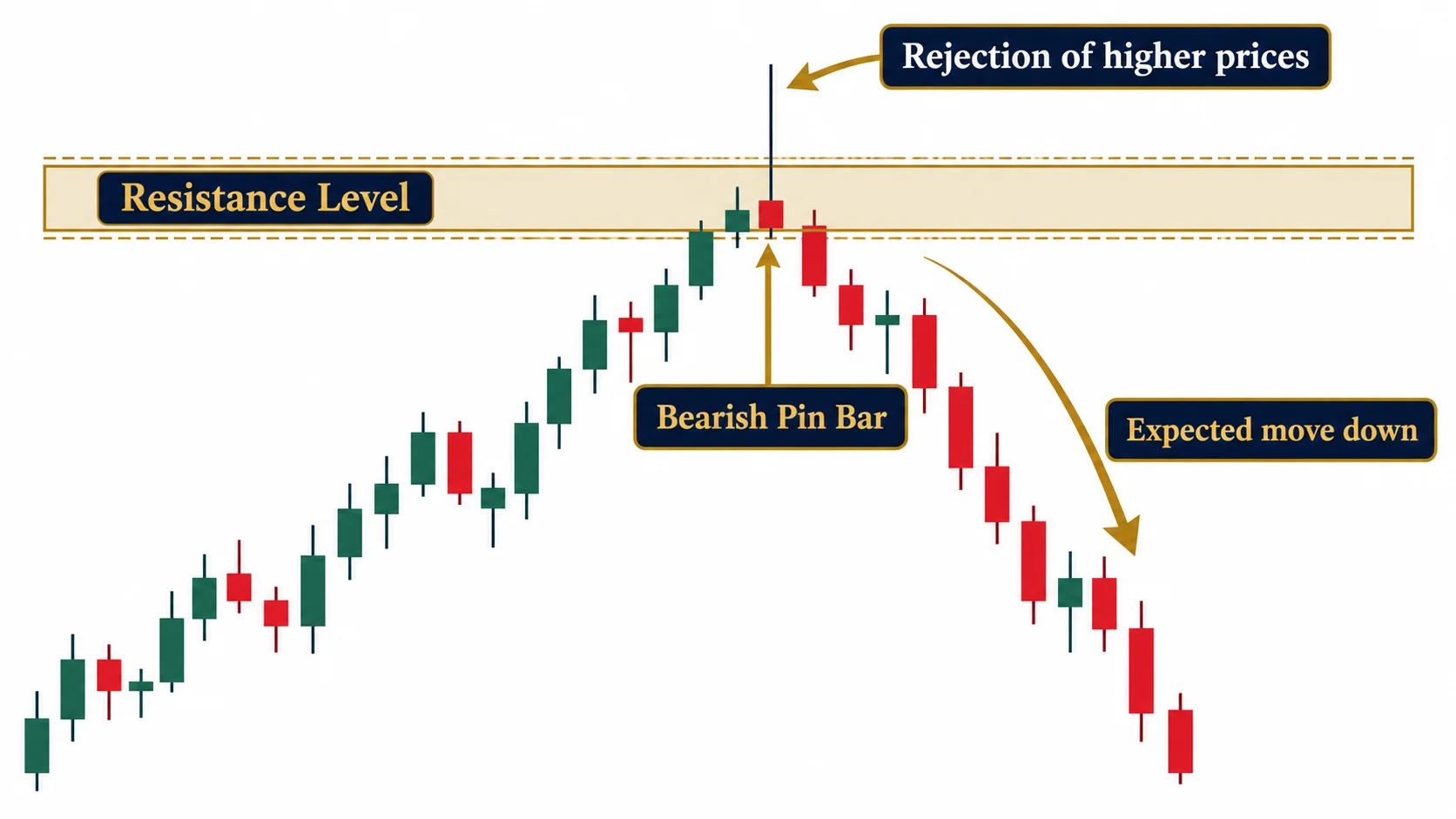
Not all wicks are the same, but you need to understand that the size of the tail shows how strong the turn is. I like the tail to be at least two to three times the size of the candle body. If the body is too big, it is not a pin bar. It is just a candle. If you want to master another reliable setup, How to Trade Bullish and Bearish Engulfing Candles in Forex will show you how to spot them without getting trapped.
Look to the left. Does the wick go past an old high or low? If it does not, it is a weak signal. A real move sweeps the orders sitting past that high or low. Look for that quick break and snap back.
Structuring Your Entry and Confirmation Rules
You do not have to enter the moment the candle closes. Waiting for confirmation often saves your account. You can enter at the close of the pin bar. This is aggressive. Or you can wait for a smaller move on a 15 minute chart. This is conservative.
Aggressive means you get a better price, but you might lose more often. Conservative means you miss some big moves, but you stay out of bad trades. For my first year, I was always aggressive. I thought I was smart. I was just impatient. I kept losing because I did not wait for the market to confirm the turn. Now, I often wait for a small re-test.
Where to Place Your Stop Loss and Take Profit
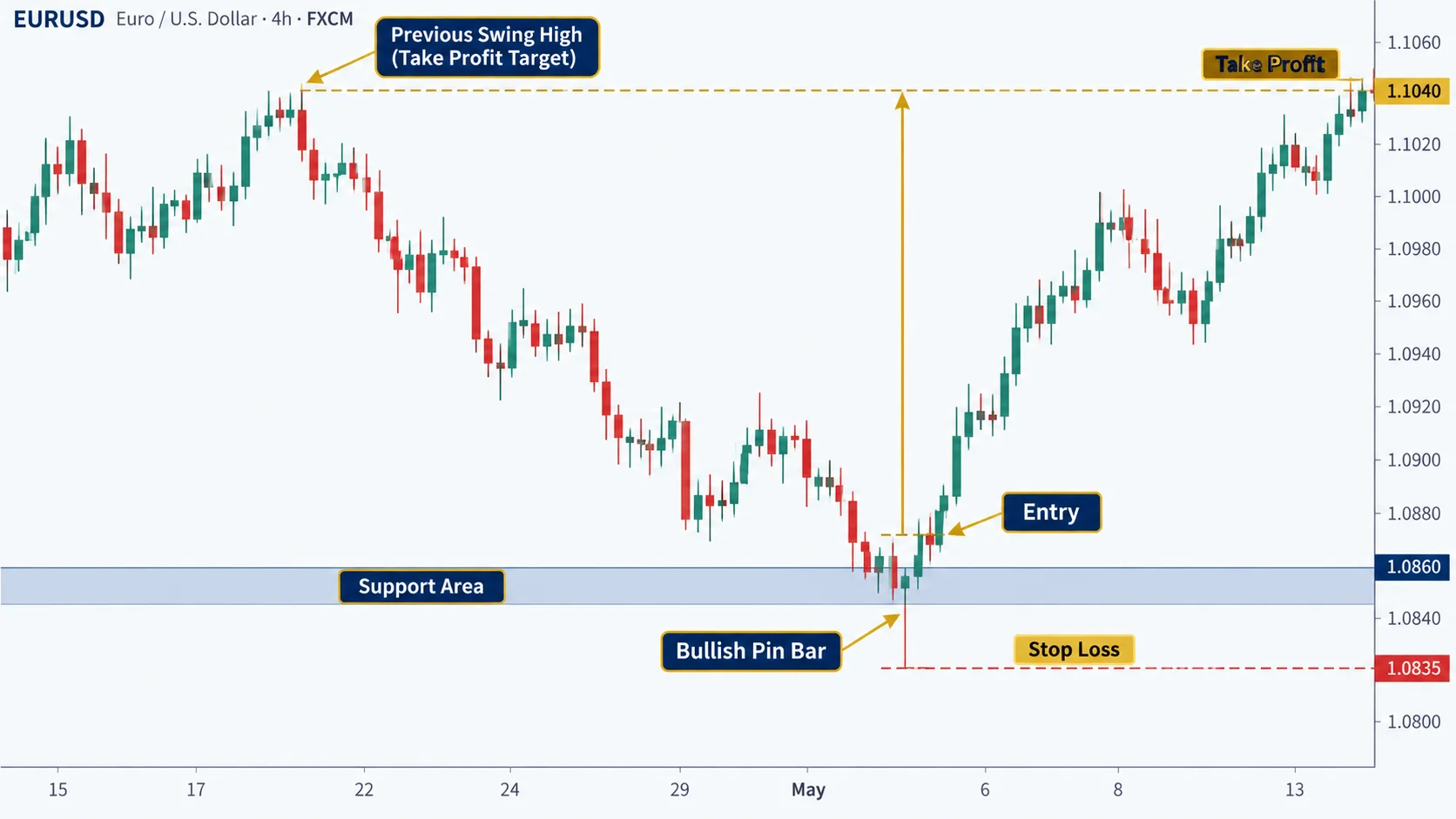
Amateurs put their stops right at the tip of the wick. Banks know this. They push price just past that tip to hit your stop before the real move starts. Give your trade room to breathe. Put your stop a few pips past the wick's end. Add a little extra for the "spread",the small fee your broker takes.
For your target, look left. Find the next clear support or resistance level. If you risk 30 pips, aim for 60 pips. This is a 1:2 reward ratio. I am not your financial adviser, this is only what worked for me.
Combining Pin Bars with Moving Averages and Momentum
A pin bar is good. A pin bar with other reasons to trade is better. I like to add a 50 period moving average on the 4 hour chart. If price hits this line and prints a pin bar, I am much more interested. It shows the trend is still strong but taking a breath.
You can also use the RSI indicator. Look for "divergence." This is when the indicator disagrees with the price. Keep it simple. One level, one trend line, and one pattern are plenty.
Real World Chart Example: Trading a Pin Bar on AUDUSD
Let us look at a real trade. On the 4 hour AUDUSD chart, price hit a major support level at 0.6500. It dipped 15 pips below it. This caught all the early buyers.
Then it shot back up. The candle closed above the support with a tiny body. That was our bullish pin bar.
I entered just above the high of that candle. I put my stop 15 pips below the wick. Price went up to the next high, giving me a 1:3 return. Everything lined up perfectly.
Common Mistakes That Will Ruin Your Pin Bar Strategy
Avoid these mistakes to save your account:
Trading pin bars in a messy, sideways market.
Trading against the main trend when it is very strong.
Putting your stop loss right at the tip of the wick.
Risking more than 1% of your money.
Trading a pin bar hours after it has already moved.
Fix these before you trade bigger sizes. The setup is simple, but your discipline must be hard as rock.
Reality Check
Most people read this and go back to trading every tiny pin bar they see. That is a mistake. Information does not make you money. Practice does.
This takes months to master. You will misread wicks. You will lose money. You will enter too early. Practice on a demo account for six months before you use real money. There are no shortcuts.
Where To Read Next
Build your skills with these guides:
How to Trade Bullish Engulfing Candles in Forex (coming soon)
How to Read Bullish and Bearish Candlesticks in Forex (coming soon)
- How to Read Candlestick Patterns for Beginners in Forex
- How to Trade Hammer and Shooting Star Candles in Forex
- How to Trade Bullish and Bearish Engulfing Candles in Forex
- How to Read Bullish and Bearish Candlesticks in Forex
- What Are Morning and Evening Star Patterns in Forex?
Frequently Asked Questions
How do I trade a pin bar without getting caught in fake moves?
Only trade pin bars at major daily or 4-hour levels. A pin bar in the middle of nowhere is just noise.
Why do my stop losses keep getting hit?
You are probably placing them exactly at the wick tip. That is where the banks hunt for stop losses. Place your stop a few pips behind the tip to be safe.
Is this strategy profitable?
Yes, if you use good risk management and only trade at the right levels. Most people fail because they trade too often.
What is the difference between a pin bar and a hammer?
A hammer is a type of bullish pin bar that happens at the end of a downtrend. All hammers are pin bars, but not all pin bars are hammers.
How much should I risk?
Never risk more than 1% of your account on one trade. If you have 1,000 dollars, do not lose more than 10 dollars on one setup.
Found this helpful? Share it with someone who needs it.