If you sit in front of your charts from morning to night hoping something will happen, the ict silver bullet strategy may be the change you need, because it asks you to show up for one hour, not ten. It works on a simple idea: there are certain times of the day when the market is pushed to move, and if you learn to read just one of those hours well, you can stop staring at candles all day.
Many beginners believe that more screen time means more money. They try to catch every move from Sunday night to Friday evening, and they end up taking trades in the middle of the afternoon when the market is barely moving and there is no real reason for price to go anywhere. The Silver Bullet works the other way round. It is a time-based model that looks for one very specific kind of gap in price, during the windows when the big banks are most active. You are not trying to guess the whole day. You are only looking for one clean trade inside a sixty-minute window.
Why Timing Matters So Much in the ICT Silver Bullet Strategy
The market does not move at random rather moves in cycles of time and price, and in this model time matters even more than price. The ict silver bullet strategy is built on the idea that at certain hours of the day the computer programs that run much of the market go looking for liquidity.
Liquidity simply means orders waiting to be filled, and you can think of it like fuel for a car. The market needs to "collect" orders before it can travel far. Most of those orders sit just above old highs or just below old lows, because that is where traders put their stop losses. When price reaches those levels, the orders are triggered and the market gets a sudden burst of energy. All of this becomes much easier to see once you have a good feel for market structure, which is simply the pattern of highs and lows on your chart.
Picture the well in a village. Early in the morning and again in the late afternoon, everyone arrives with their buckets, the rope never stops moving and the whole place is busy. At midday you can stand there for an hour and hardly see anyone. The Silver Bullet window is like the busy hour at the well, a regular appointment when the market goes out to collect its fuel. It comes three times a day, and if you are not at your screen then, you will probably miss the moves with the best chance of working.
How the Market Mechanics Actually Work
To understand why this strategy works, it helps to know what is happening behind the scenes. The market is an organised system that matches buyers with sellers, and during the Silver Bullet hours it often goes through a kind of "rebalancing" act. If you would like the wider picture of how these big players think and why they leave the footprints we trade, I wrote it all out in How to Use Smart Money Concepts for Retail Trading Strategy, and it is worth reading before you place your first Silver Bullet trade.
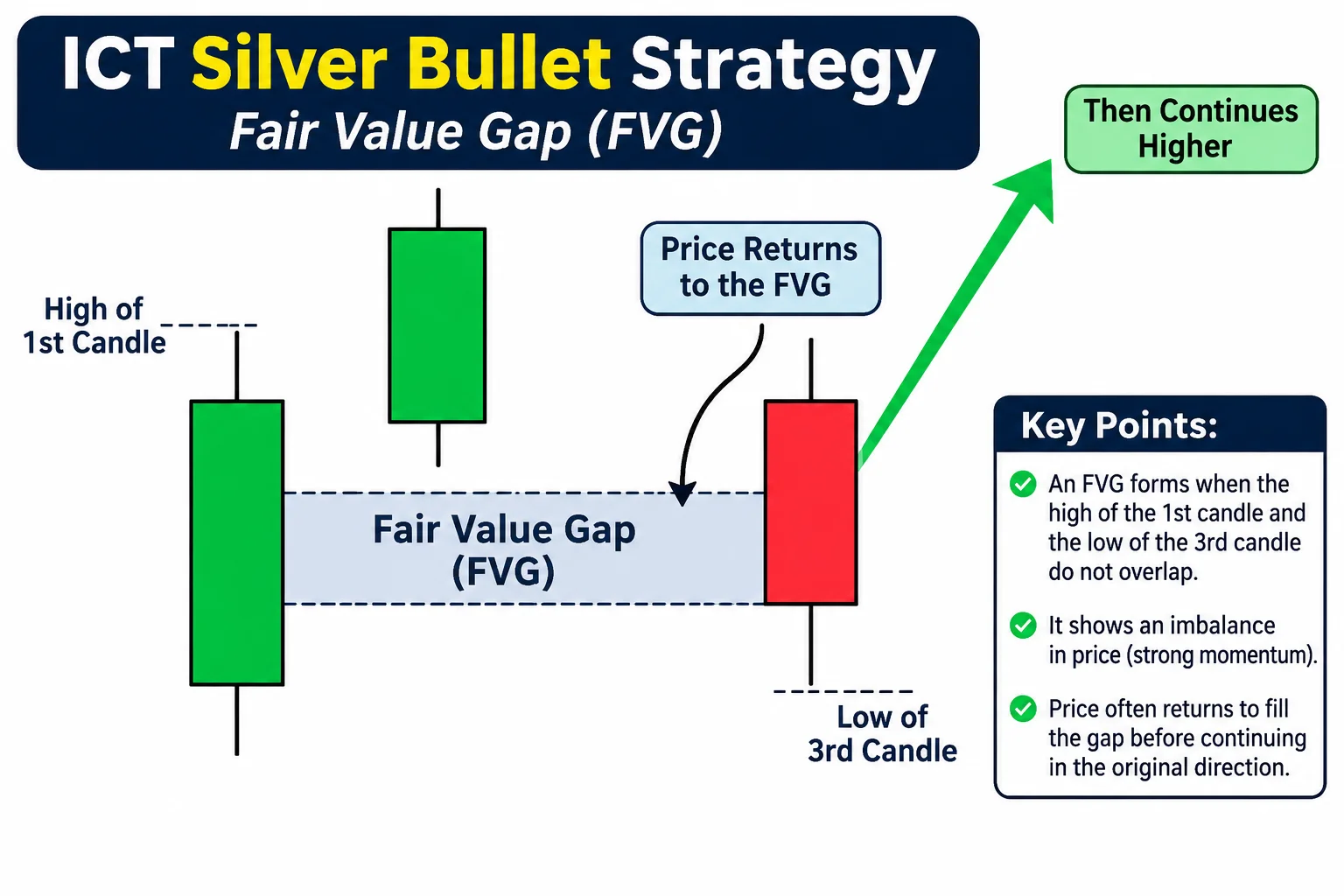
When price moves very fast in one direction, it leaves a kind of "hole" behind it, a stretch of price where only buyers or only sellers took part. That hole is what we call a Fair Value Gap. The market often likes to come back to these holes to "fill" them and make trading fair again before it carries on, which is exactly the return we wait for.
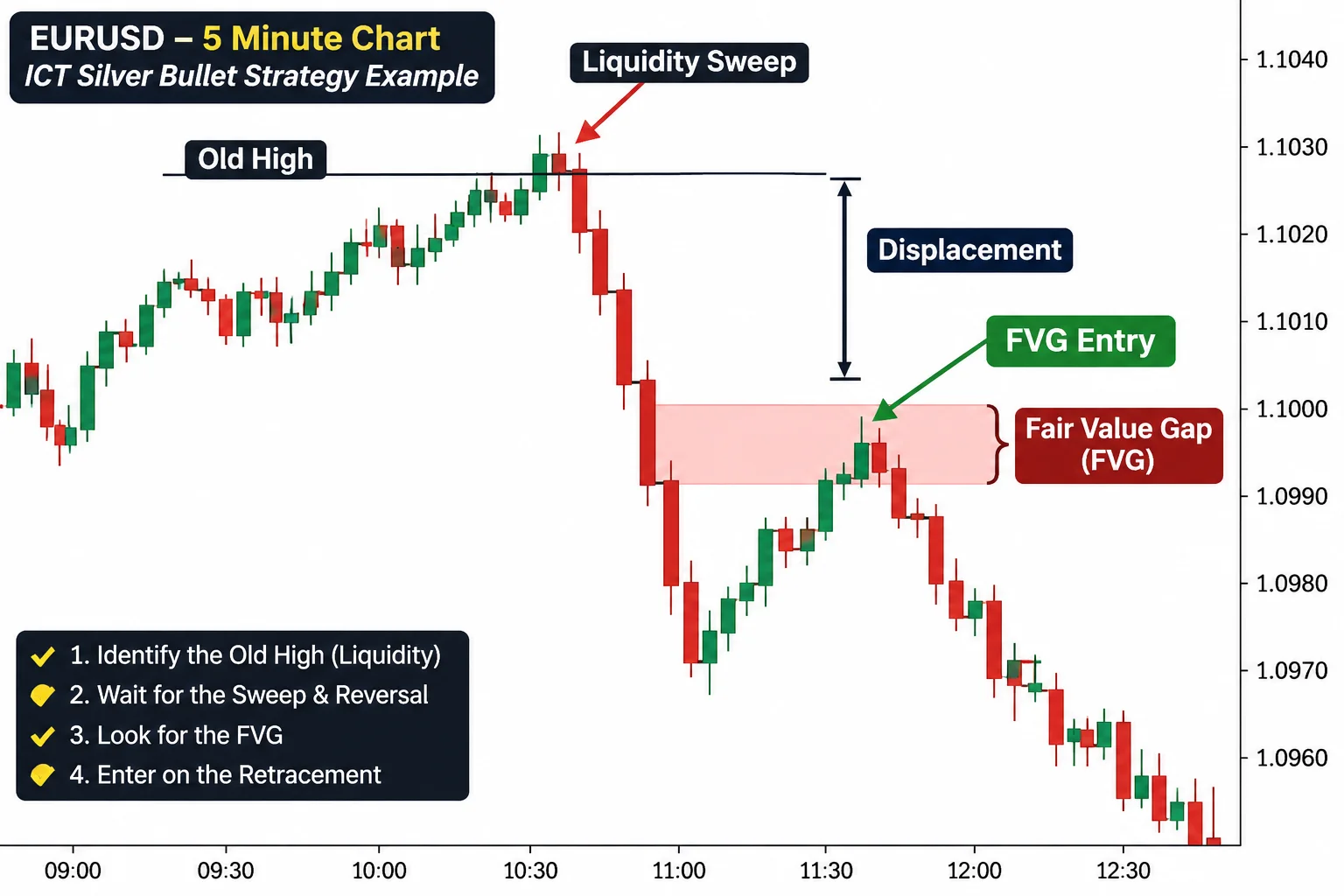
During the Silver Bullet windows the market is busy looking for these gaps to fill, or for old highs and lows to sweep, and it does this in a very regular way. The big banks use these hours to place large orders because there is enough activity to hide what they are doing. When you see a sudden, sharp move that leaves a gap behind, that move has a name in this model: displacement. It simply means price moved away with real speed and force, and it shows you where the big money wants to go. Your only job is to wait for price to come back to that gap so you can join the move. You will find that tracking these big bank footprints is much easier once you understand What Is Smart Money Concepts in Forex for Beginners.
The Three Windows You Need to Watch
You do not need to be awake for all three. I suggest you pick the one that fits your life and stick to it, because doing one window well is better than trying all of them and making mistakes because you are tired. All the times below are in New York time (EST/EDT), so you will need to change them to your local time. If you are struggling to find time for these windows, I wrote How Much Time Do You Need Every Day to Trade Forex? to help you plan.
The London Open: 3:00 AM to 4:00 AM. This is often when the direction for the London session is set.
The New York AM Session: 10:00 AM to 11:00 AM. This is my favourite window because it usually comes after the wild early-morning moves have calmed down.
The New York PM Session: 2:00 PM to 3:00 PM. This is the afternoon move, often used to finish off the day's trend.
If a window falls in the middle of your night, you will be too tired to read the chart properly, so choose the hour you can attend wide awake, week after week, and treat it like an appointment.
What a Fair Value Gap Actually Looks Like
The heart of the ict silver bullet strategy is the Fair Value Gap, or FVG. Picture a row of three candles. If the top of the first candle and the bottom of the third candle do not touch, the empty space between them, inside the range of the middle candle, is the FVG.
It is like a gap in a fence. Price moved through that area so fast that it did not have time to trade with everyone who wanted to take part, and sooner or later it usually comes back to "close the gap" before it continues. We look for this gap to form inside our sixty-minute window, not before it and not after it.
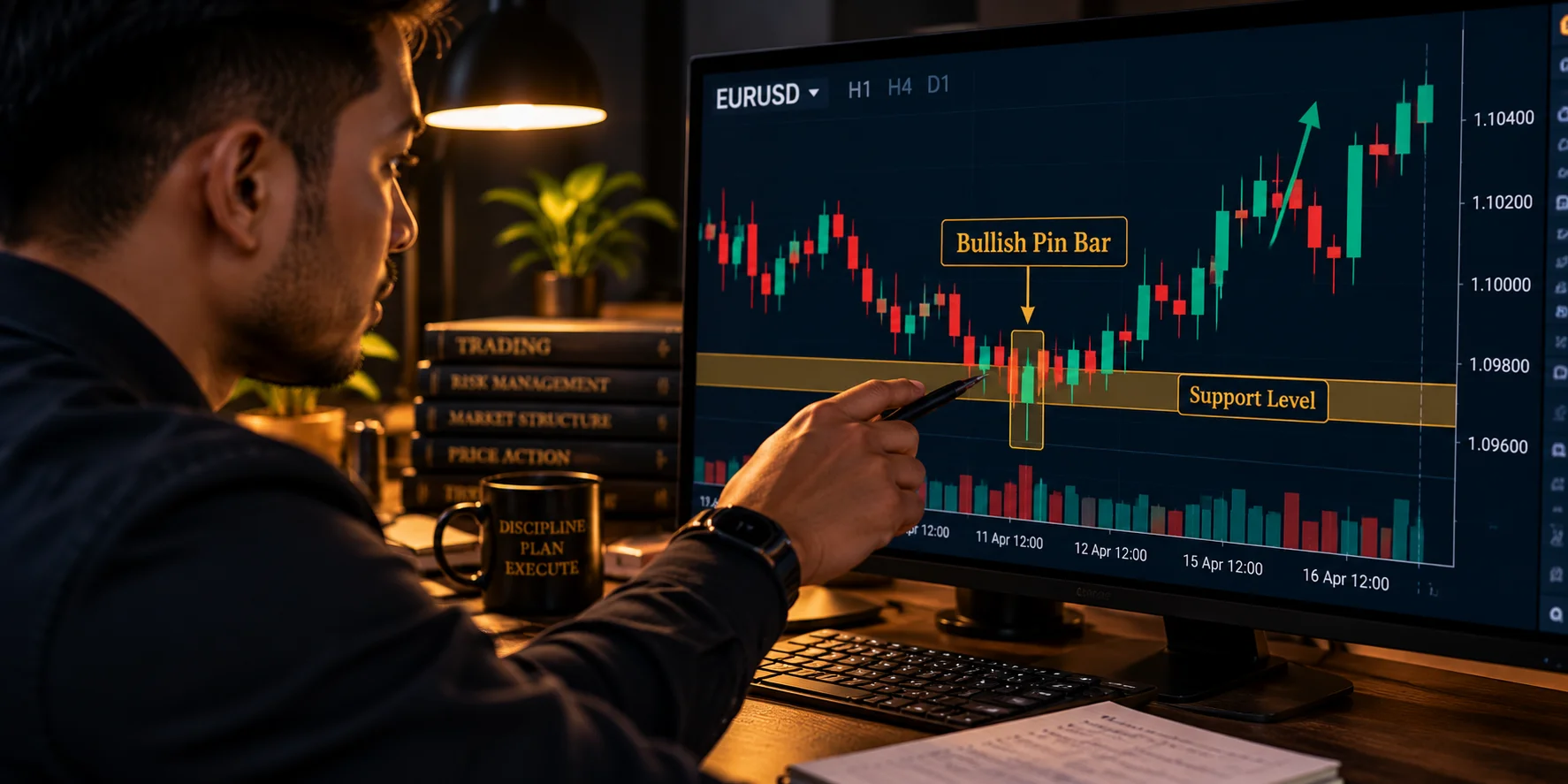
When I see a gap, the first thing I check is what happened just before it. Did the market take out an old high or low, then move away with speed? If there was no sweep and no real speed behind the move, the gap is most likely just noise, and I leave it alone. If you struggle to identify these price sweeps, How to Trade a Pin Bar Candlestick Strategy in Forex will help you spot the trapped money behind them.
How to Set Up Your First Silver Bullet Trade
Trading this model is like following a recipe, step by step, in the same order every time. I use the 5-minute or the 1-minute chart for my entries once the window opens.
First, wait for the clock to reach the start of your window. Then watch for price to push above a recent high or below a recent low, which is the market collecting its fuel. Once that happens, you want to see a sharp move in the opposite direction, and that sharp move is the displacement we talked about earlier. If you struggle to tell the difference between a real setup and a trap, What Is Inducement in SMC Forex and How to Spot It? explains how to avoid getting tricked.
Now look for the FVG that the sharp move left behind. I place my entry at the start of that gap, and my stop loss goes just above the high of the move that created the gap if I am selling, or just below its low if I am buying. It is a very mechanical way to trade, because you are not guessing but reacting to something the market has already done.
Why Most Beginners Fail with This Model
The biggest reason traders fail with the ict silver bullet strategy is a lack of patience. They see the window open and feel that they must take a trade. But on some days the market simply does not give you a clean setup, and if there is no sweep of an old high or low and no clear gap, then there is no trade.
Another mistake is "dragging" the stop loss further away when price moves against you, hoping to give the trade more room. In the Silver Bullet model, if price moves past your stop, your idea was wrong, and the right thing to do is accept it, take the small loss and wait for the next window.
You also have to be careful with your lot size, which is simply how much of a currency you are buying or selling. Because the Silver Bullet often uses small stop losses, it is very easy to pick a lot size that is far too big. If you risk too much on one trade, your emotions will take over and push you into mistakes, so I suggest risking no more than 1% of your account on any single setup. Before you risk your capital, you must understand What Is a Lot Size in Forex Trading? so you do not accidentally trade more than your account allows.
Managing Your Risk on a Small Account
If you trade a small account, the Silver Bullet can suit you well because the stops are tight. But "tight" does not mean "safe" if you use too much leverage. Leverage is when your broker lets you control a large amount of money with a small deposit, and it cuts both ways, so it can hurt you just as quickly as it helps you. It is very important to learn What Is Leverage in Forex Trading and How Does It Work? because it can quickly turn a small mistake into a big loss.
I always tell new traders to focus on the process, not the money. If you have a 1,000 dollar account and you risk 10 dollars (1%) on each trade, you can be wrong 10 times in a row and still have about 900 dollars left. But if you risk 100 dollars per trade because you want to get rich quickly, three losses will leave you panicked and making poor decisions.
I am not your financial adviser, and this is only what has worked for me. What I can tell you is that trading gets better when you stop watching your balance and start checking how well you followed your rules. The Silver Bullet is a tool, and like any tool it only works when you use it the right way and stop trying to force it into situations where it does not fit.
The Part Most Traders Never Figure Out
The real edge in the ict silver bullet strategy is not the gap itself. It is the story behind it. You need an idea of where the market wants to go on a higher timeframe, such as the 1-hour or the 4-hour chart, and if the bigger trend is up, you should only look for buying Silver Bullet setups inside your window.
I made this mistake for months. I took every Silver Bullet I saw, even when it went against the main trend, and my results went up and down like a rollercoaster. Once I only took trades that agreed with the daily direction, I did not suddenly win more often, but my good trades lasted longer and were much cleaner. It felt like swimming with the current instead of against it.
So look at the daily chart before your window opens and ask yourself one question: "Is the market more likely to reach for yesterday's high or yesterday's low?" Once you have that leaning, which traders call your bias, you simply wait for your sixty-minute window to give you an entry in that direction. This one small filter will keep you out of a lot of losses you never needed to take. To get better at picking your direction, I suggest you study How to Find Daily Bias in Forex Without Forcing Direction to keep your trades in the trend.
Where To Read Next
A time-based model makes far more sense once you understand how the market is built underneath. These are the best places to carry on:
- How to Use Smart Money Concepts for Retail Trading Strategy
- What Is Inducement in SMC Forex and How to Spot It?
- How Much Time Do You Need Every Day to Trade Forex?
- How to Trade a Pin Bar Candlestick Strategy in Forex
- How to Find Daily Bias in Forex Without Forcing Direction
- How to Determine Market Direction Using Swing Highs and Lows
Frequently Asked Questions
How do I trade the ICT Silver Bullet on a small account?
Use a small lot size and risk only 1% of your balance on each trade. Because the entries are precise, your stop loss is often small, which is why the model can suit accounts as small as $500.
Is the ICT Silver Bullet strategy actually profitable for beginners?
It can be, as long as you have the discipline to trade only inside the set time windows. Steady results come from following those time rules, not from chasing chart patterns on their own.
What is the best timeframe for the ICT Silver Bullet?
Use the 1-minute or 5-minute chart for your entries, and always check the 1-hour chart first to confirm which way the market is leaning.
What is a Fair Value Gap in forex?
An FVG is a three-candle pattern where a "hole" is left between the wicks of the first and third candles. It shows that price moved out of balance, and the market often comes back to fill it.
Can I trade the Silver Bullet on any currency pair?
It works best on busy pairs like EURUSD or GBPUSD, because they have enough buyers and sellers to make the time windows dependable.
Many people will read this, feel excited, and try to trade every gap they see tomorrow morning, ignoring the time windows and risking far too much money. Information on its own does not make you a trader. What really separates steady traders from everyone else is the ability to sit on your hands and wait for the right sixty minutes, and that takes time to learn, so give yourself a few months of practice before you expect to see steady results.
If this helped you, send it to a friend who is learning to trade.