
You see a clean pullback after a strong move, you take the trade, and the market hits your stop loss by a hair before flying off in the exact direction you picked. If that has happened to you more than once, you have already met inducement in smc forex, even if nobody told you its name, and it starts to feel very personal, as if the market is watching your screen.
I used to believe my broker was going after my own 50 dollar risk. The market was never looking for my small trade on its own, but it was looking for the thousands of trades that looked just like mine, with their stops sitting in the same place.
That fake move before the real one has a name in Smart Money Concepts, and we call it inducement. Once I learned to spot it, I stopped being the fuel for the move and started waiting until the trap had already closed before I joined in.
What Is Inducement in SMC Forex?
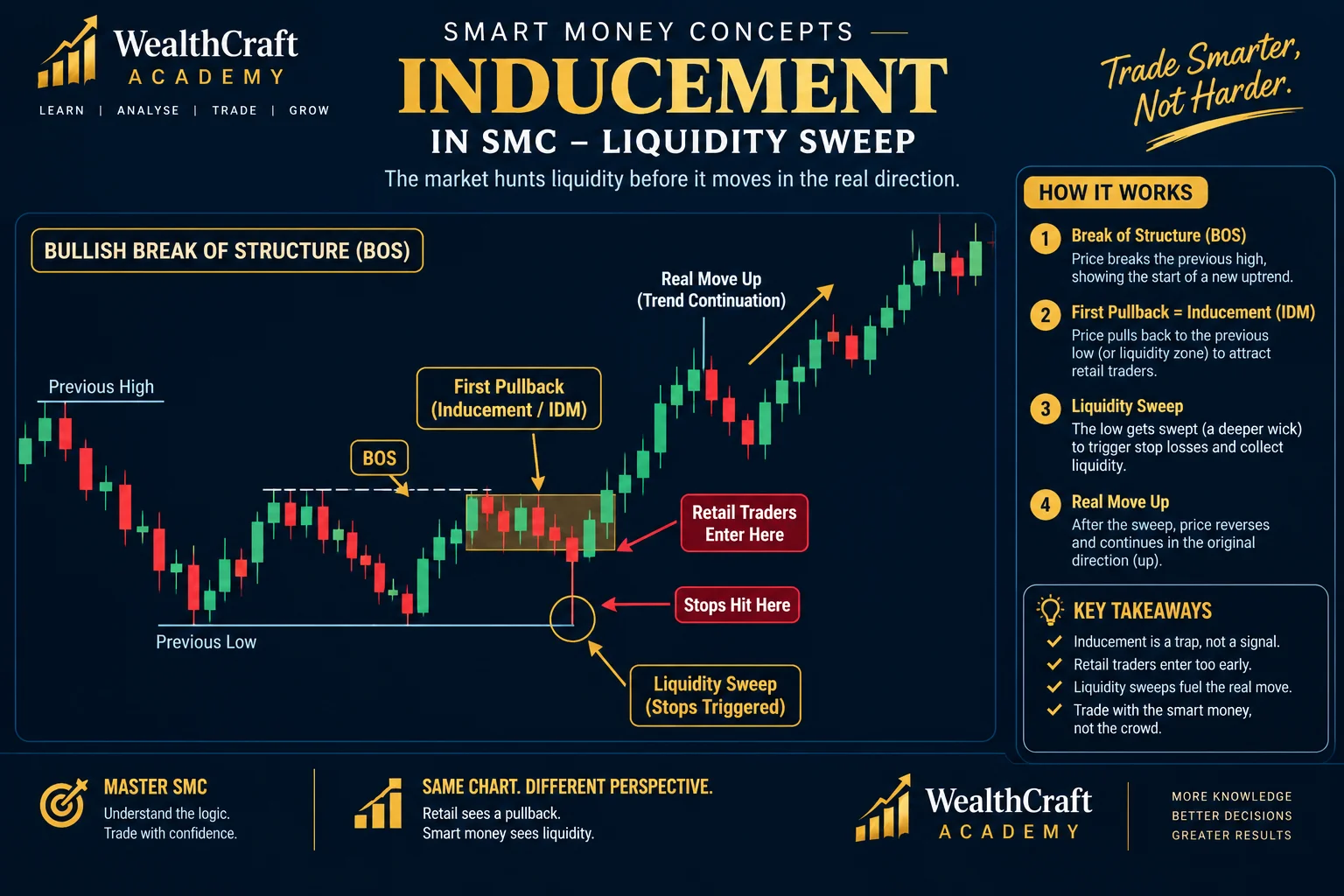
Inducement is a trap. It is a small price move that looks like a good entry signal, but its real job is to pull ordinary traders into the market too early so their orders can be used later.
I like to think of it as the market tempting you to press the button. It builds a pattern that looks exactly like the one you were shown in a basic trading book, and then it sweeps those orders away to find the real buyers and sellers it needs to make its move.
In Smart Money Concepts (SMC), inducement is usually the very first small pullback inside a move after a break of structure, which simply means price has pushed past an important high or low. If you take a trade at that first pullback, there is a good chance you are the inducement. I was that person for a long time, until I realised the market needs a reason to turn, and very often that reason is your stop loss. If you are just starting your journey, you should read What Is Smart Money Concepts in Forex for Beginners to understand the big picture.
The Real Reason the Market Traps You
Price moves from one place to another to find liquidity, which is just a plain word for orders waiting to be filled. Think of liquidity as the fuel in a car, because without it nothing moves. The big banks cannot simply buy 500 million dollars of EUR/USD at one price, because the price would jump and they would get a terrible fill. They need thousands of sell orders to match against their buy orders.
This is where inducement comes in. By building a fake support level or a small pullback, the market encourages ordinary traders to put their stops in one small area. When price later runs into that area and sets off those stops, it is really just filling the big orders, and once you understand how the big players move price, the whole thing stops looking random.
Picture the food at a big wedding. Before the main buffet opens, the staff put out a table of bread rolls and small snacks, and the hungry guests rush over and fill their plates. By the time the real food arrives, those guests are already full and standing at the back of the queue. Inducement is that first table of bread rolls, and the traders who rush to it are the ones who are out of the trade when the real move starts.
How to Spot Inducement on Your Chart
Finding inducement is actually quite simple once you train your eyes to look for it, because it is almost always the highest or lowest point of the first pullback after price breaks a major level.
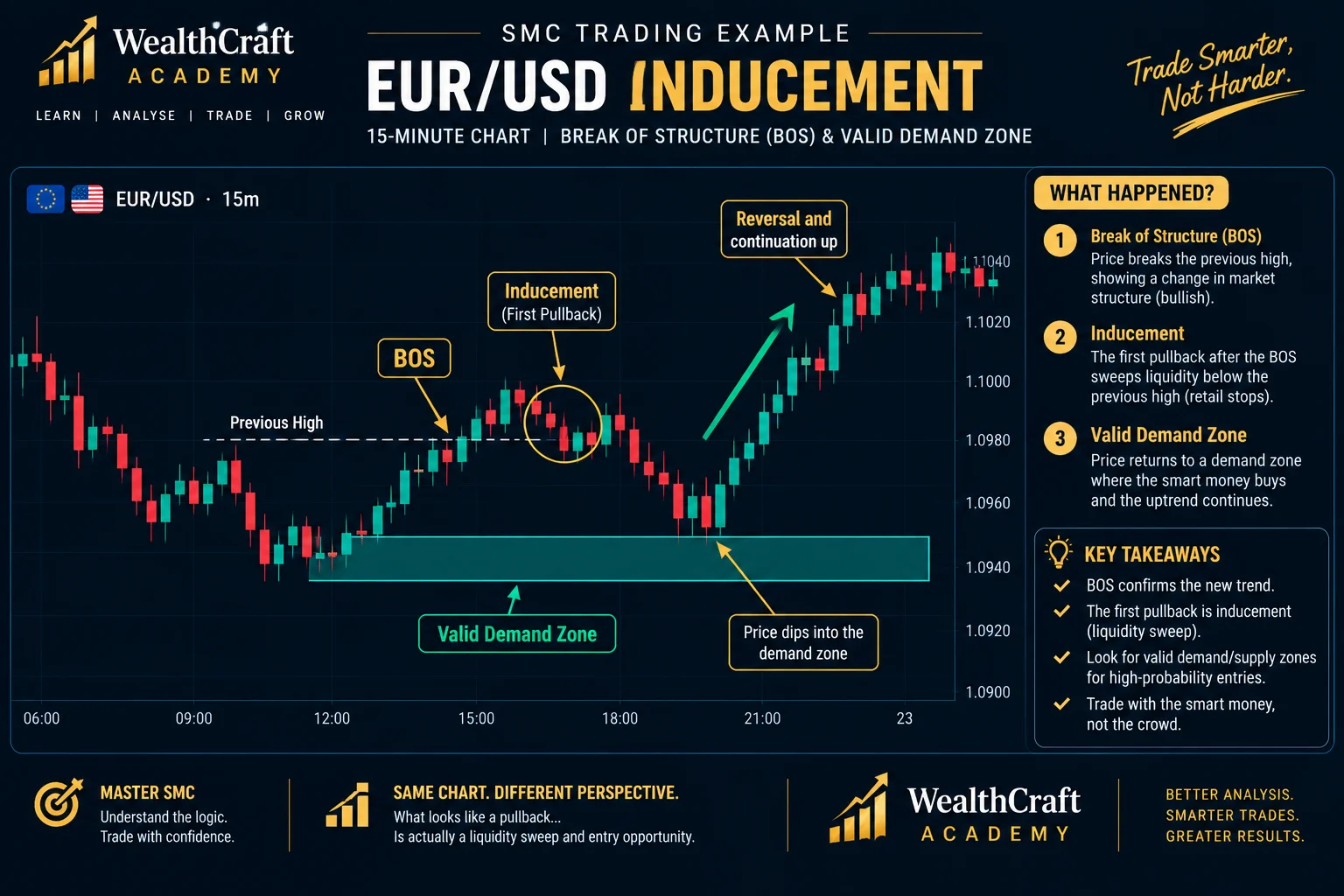
If the market is going up and breaks above a previous high, we call that a Break of Structure (BOS). After that break, price will sooner or later pull back, and I wait for that to happen, because the first pullback is usually the inducement. In my experience, the real demand zone or order block, which is the area where the big buying started, often sits just below that inducement. The market comes down, sweeps the low of that first pullback, sets off the stops, and then taps into the real order block. Before you look for inducement, you must master the basics by studying What Is BOS in Forex and How Do You Trade It properly.
The Rule of the First Pullback
Look at your recent high, then follow the price back down until you find the first small low that formed before price carried on up to break the structure. That small low is your inducement level.
When I find it, I look for the zone that sits behind it. If there is no inducement at all, I often leave the trade alone, because the market has not cleared the path yet and the move has nothing underneath it to feed on.
It is like a security check at the door. The market clears out the early, nervous traders before it is ready to make the big move, and if you walk in before the check, you are the one being cleared out.
Why Most Traders Get Inducement Wrong
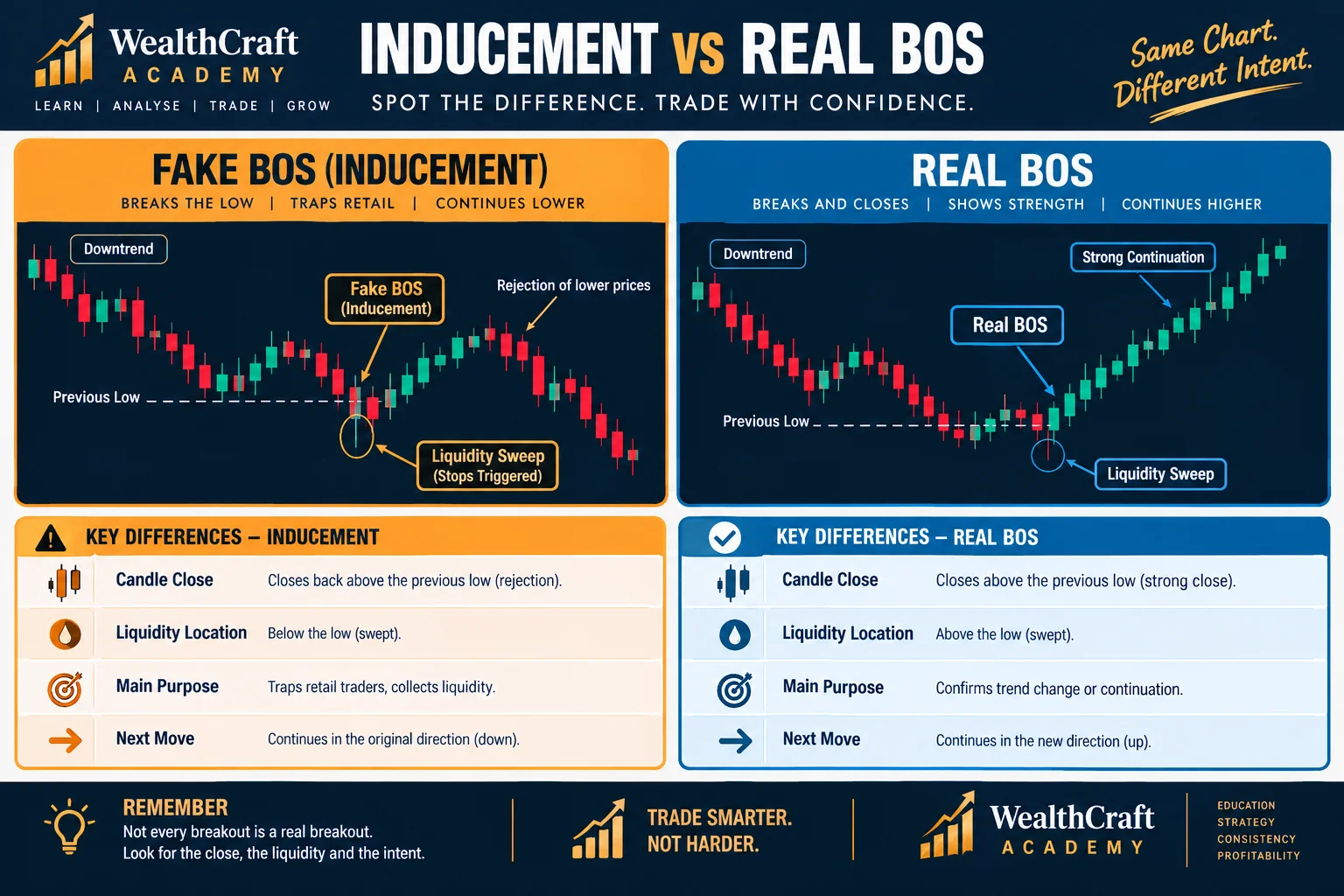
The biggest mistake I see is mixing up inducement with a real Change of Character (CHoCH), which is the moment the trend actually flips. Inducement is only a short trap inside the same trend, so the two can look alike for a few candles but mean very different things. I always tell my students to study What Is a Change of Character in Forex and How to Trade It? so they stop confusing it with inducement.
When price sweeps the inducement, it can look like a reversal for a moment. A big red candle might break the small low, and many traders see this and start selling because they think the trend is over. That is exactly what the people moving the market want you to do.
So when I see a small low broken, I keep my hands off the keyboard until the inducement has been taken. Over time I learned that a sweep of inducement is a signal to join the original trend, not a reason to bet against it.
The Difference Between Inducement and BOS
A Break of Structure (BOS) happens when price closes beyond a major high or low in a trending market, and it tells you the trend is carrying on. Inducement happens inside that move, so the order usually looks like this: Once you see the structure break, you should learn What Is a Market Structure Shift in Forex and How to Trade It? to spot the real reversal.
Price breaks a high (BOS).
Price makes a small move down (Inducement).
Price sweeps that small move down (The Trap).
Price hits a deep demand zone and continues the trend.
If you cannot see the inducement, you might think the market is just messy. But the market is rarely messy, because most of the time it is simply busy collecting orders, and a wick that looks random usually has a reason behind it.
I find it helps to think of inducement as a magnet. Price is drawn to it because that is where the orders are, and once those orders have been collected, the magnet loses its pull and price moves away.
How to Trade the Inducement Sweep
So how do you actually use this to make better trades? It mostly comes down to patience, because you are waiting for the market to do the dirty work of hitting other people's stops before you get involved.
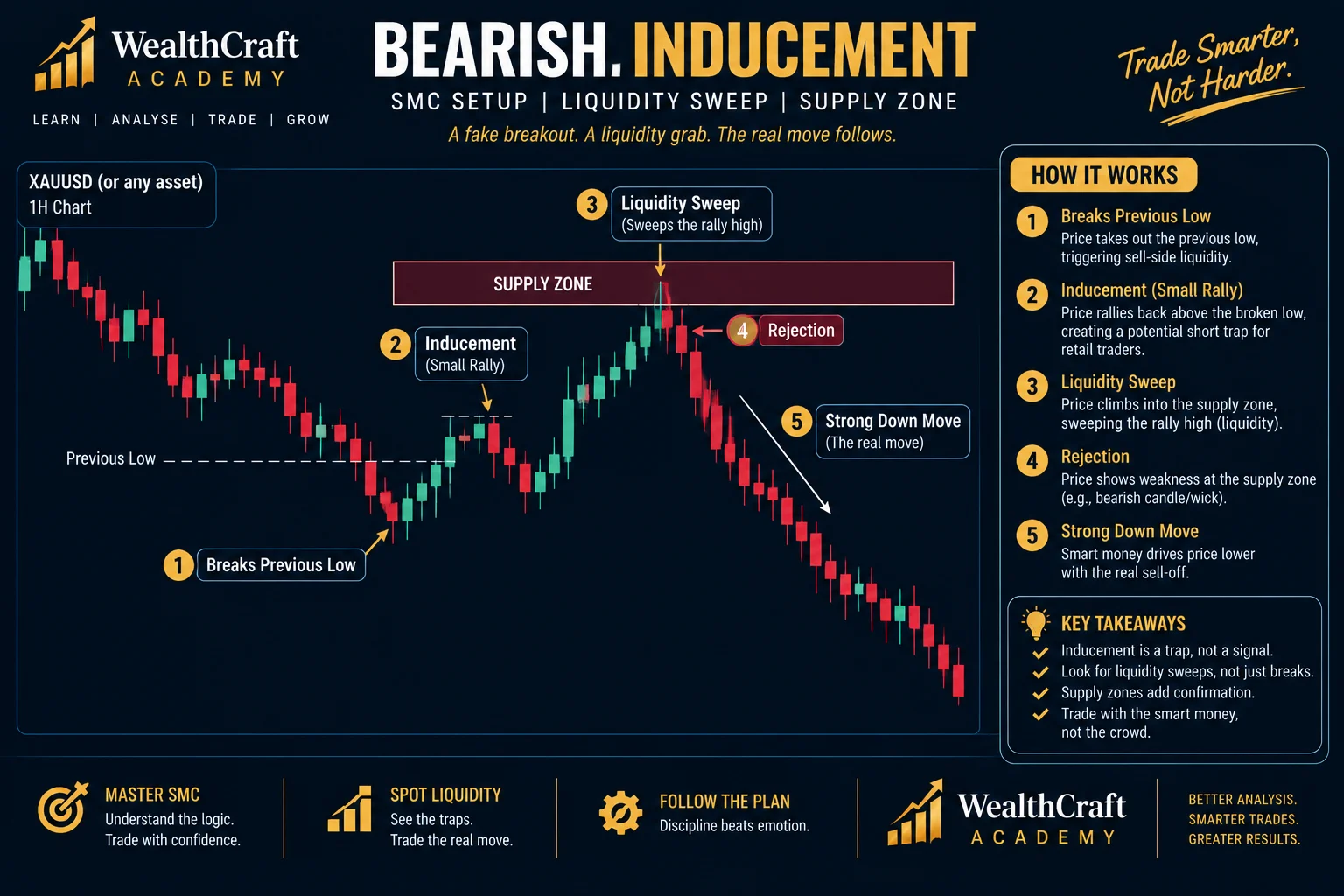
First, find your trend and the most recent Break of Structure. Second, mark the inducement level. Third, look for a good order block or Point of Interest (POI), which is just the zone you plan to trade from, sitting below the inducement in a rising market or above it in a falling one.
Then wait for price to take out the inducement. I do not mean just touch it, because I want to see a wick or a candle sweep right through it. Once those orders are grabbed and price taps your zone, you look for your entry on a lower timeframe, like the 1-minute or 5-minute chart. When you drop down to the smaller charts for your entry, you will find How to Trade Micro Market Structure on Lower Timeframes very helpful indeed.
I will be honest, it is hard to wait, and your brain will keep telling you the market is leaving without you. But the trades I take after an inducement sweep have worked out far more often than the ones I rush into.
A Realistic Example on GBP/USD
Let us walk through a real scenario. Imagine GBP/USD is going up on the 4-hour chart, and it breaks 1.2500 to make a new high, which gives us our BOS.
Price then pulls back to 1.2450 and moves up again, but it fails to make a new high, so that 1.2450 level becomes our inducement. I look further down and see a clean order block at 1.2410 that price has not touched yet, so I wait. Price eventually drops through 1.2450, which makes everyone think the trend is dead, then it taps 1.2410, leaves a sharp wick, and flies back up to 1.2600. To truly understand why that sharp wick happens at your order block, you should look at How to Read Candlestick Wicks and Shadows in Forex Trading.
If I had bought at the inducement at 1.2450, I would have been stopped out. By waiting for the sweep into the 1.2410 zone, I got a better price and a safer trade, and that is the whole difference between being the liquidity and trading alongside it.
My Own Habit of Entering Too Early
When I started learning SMC, I honestly thought I was smarter than the traders who used plain support and resistance. I drew my little boxes and waited, but I was still losing money, and I could not understand why my order blocks kept failing. If you want to see how all these pieces fit together, How to Use Smart Money Concepts for Retail Trading Strategy lays out the full picture, and it is the lesson I wish I had read before I drew my first box.
In the end I realised I was always picking the very first block I saw. I did not understand that the market often breaks a fake block first to gather the energy it needs to move from a real one, so I was treating every pullback as a golden chance.
The habit that changed things for me was a simple inducement check. Before I place an order, I ask myself, "Is there a pullback between me and the current high or low?" If the answer is no, I am probably the inducement. I am not your financial adviser, this is only what worked for me, but that one question kept me out of a lot of bad trades. If you are still struggling to find these levels on your screen, my guide How to Draw Market Structure on Forex Charts Step by Step will help.
The Hard Truth About SMC Inducement
Even when you spot the inducement correctly, you will still lose some trades, because sometimes the market does not need to sweep it and simply goes.
Trading is not about being right 100% of the time, though. It is about having a plan that puts the odds on your side, and waiting for inducement works as a filter that keeps you out of the messy, low-chance trades and points you towards the cleaner ones.
I have also seen traders get so fixed on inducement that they never take a trade at all, because they keep waiting for a perfect sweep that never comes. You have to find a balance, so use inducement as a guide and not as a cage.
Where To Read Next
If you want to build the full strategy around this, start with the core ideas that make it work.
- How to Use Smart Money Concepts for Retail Trading Strategy
- How Do You Trade the ICT Silver Bullet Strategy for Beginners?
- How to Trade Micro Market Structure on Lower Timeframes
- How to Draw Market Structure on Forex Charts Step by Step
- What Is a Market Structure Shift in Forex and How to Trade It?
- How to Use Market Structure Entry Signals in Forex
Frequently Asked Questions
What is inducement in smc forex?
Inducement is the first small pullback after a break of structure that tempts ordinary traders into entering too early. Their orders become the pool that the big players use to fill their own trades before the real move happens.
Is inducement the same as a stop hunt?
Yes, inducement is one kind of stop hunt. It describes the fake pullback that gets traders to put their stops in a weak spot, so those orders can be collected.
How do I know if a pullback is inducement or a real reversal?
A pullback is usually inducement if it has not yet reached a major demand or supply zone on a higher timeframe. A real reversal needs a strong candle close beyond the major swing high or low, not just a quick wick through it.
Should I always wait for inducement before entering a trade?
Waiting for inducement is safer for beginners, although it means you will miss some fast moves. In my experience, about 70% of good SMC setups include some kind of inducement sweep before the main move.
Can inducement happen on any timeframe?
Yes, inducement shows up on every timeframe, because the way orders gather and get collected works the same way across the whole forex market.
The Reality Check
Most traders will read this, nod along, and then go straight back to taking the very first pullback they see tomorrow morning. The idea is easy to understand, but the discipline to wait is the hard part.
For months I knew exactly what inducement was and still kept losing on small trades, because I was too impatient to wait for the sweep. You cannot rush the market, and if you jump in before the big money has cleared the path, you simply become part of what they are clearing away.
This takes time, so do not expect to see it perfectly on your first day. Open your charts, go back a few weeks, and just look for those first pullbacks that got swept. The more often you spot it in the past, the easier it becomes to wait for it in the future.
If this helped you, send it to a friend who is learning to trade.