EUR/USD, GBP/JPY, AUD/NZD: on your first day with a trading platform these look like secret codes, and yet each one tells you exactly what you are buying and what you are selling. The letters in a forex pair are three letter currency codes set by an international standard called ISO 4217, where the first two letters usually stand for the country and the third for the currency, so USD is the United States dollar and JPY is the Japanese yen.
Once you can read them, you also know which currency your profit is counted in and why the order of the two codes matters. I will walk you through how the codes work, why pairs are always written in a set order, and how to read any pair your broker offers you.
Why Currency Pairs Always Come in Pairs
The first thing that confuses people is that you cannot buy money on its own. If you want to buy US Dollars, you have to hand over something else to get them, maybe British Pounds, so you always give up one thing to get another.
That is why we call it a "pair", which is just a set of two things traded against each other, and it means you are always swapping one economy for another. This lesson is about reading the symbol itself. If you want to know how pairs actually behave once you trade them, what moves them and which ones move together, that is covered in How Do Currency Pairs Work in Forex Trading?
So when you look at your screen, try to stop seeing a line that simply moves up or down. Think of it like a doctor comparing the check-up results of two patients side by side, where each patient is a country, and the line shows which one looks stronger. If the line goes up, the first country is doing better, and if it goes down, the second one is. Reading it this way is the best way I know to understand currency exchange. The banks, companies and traders behind these moves are a story of their own, and you can get the full picture in What Is the Forex Market and Who Trades It.
The Base Currency Versus the Quote Currency
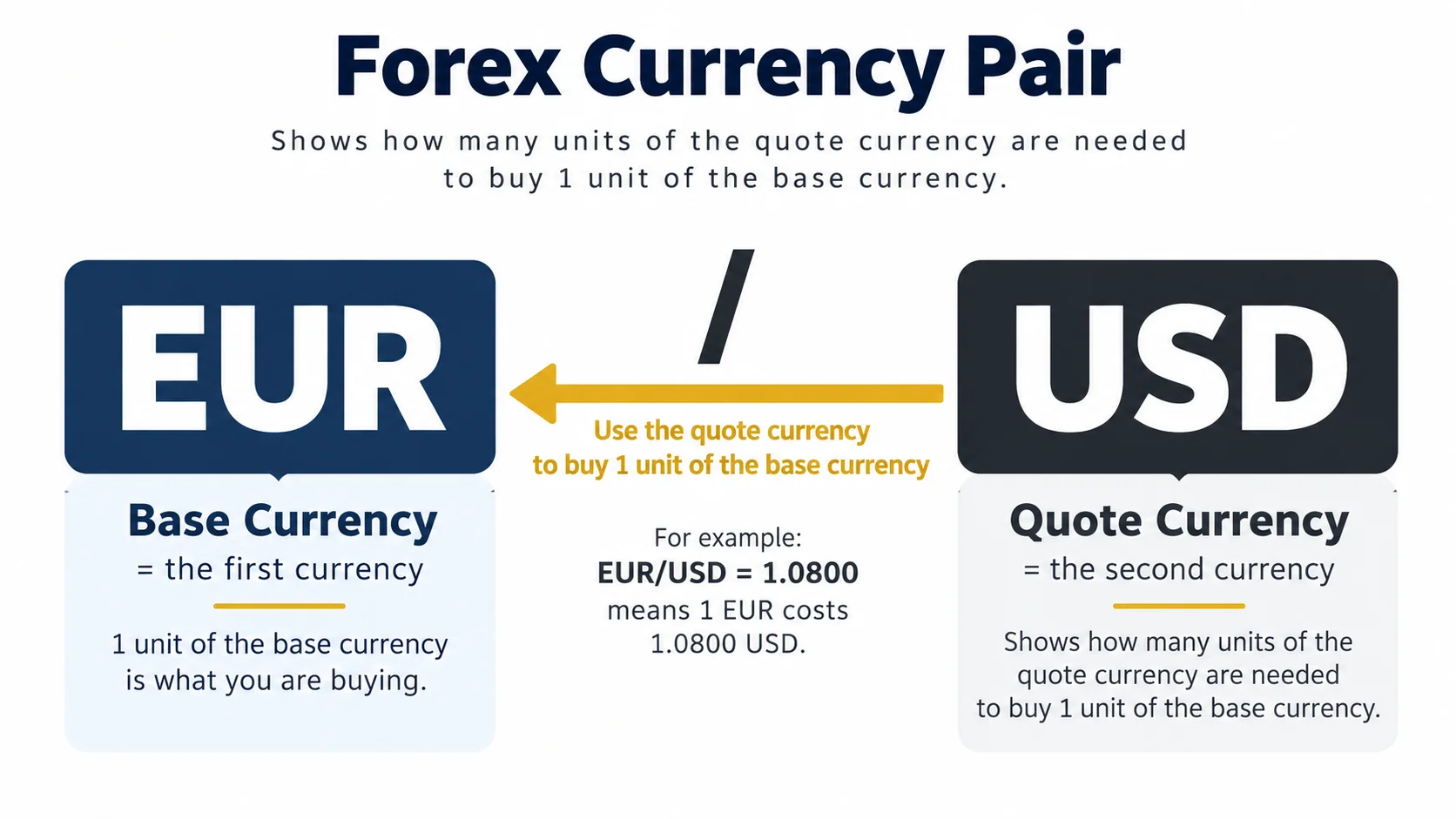
Take EUR/USD as our example. The first three letters are called the "base" and the last three are called the "quote". Think of the base as the "thing" you are buying and the quote as the "price tag" hanging on it.
If the price is 1.0850, it means one Euro costs 1.0850 US Dollars. The Dollar is the unit of measure here, because it tells you what the Euro is worth. So every currency trade is a bet for one country and against another at the very same time. Once you see how the price is measured, the next step is learning how to count your gains and losses, and What Is a Pip in Forex and How Do You Calculate It shows you how that counting works.
You are never just standing still in this market, because you always own a piece of one country while betting against the other. When I started, I thought I was simply betting on a "number", and it took me a while to see that I was really betting on a country's health.
What Happens When You Click Buy or Sell
When you hit the "buy" button, you are buying the base currency and selling the quote currency at the same moment, so you are really doing two things at once. If you buy AUDUSD, you buy Australian dollars and sell US dollars to pay for them. How much of a pair you buy matters just as much as which way you go, so before you press anything, read What Is a Lot Size in Forex Trading? and make sure you never risk more money than your account allows.
Let us use GBP/USD as an example. When you click buy, you are buying British Pounds and using US Dollars to pay for them, so if the Pound gets stronger, you make money. If you click sell, you are doing the exact opposite.
Whenever I see a pair, I check which currency is the "thing" I am holding so I do not get my directions mixed up. A lot of beginners trip over the words more than the ideas, and if that sounds like you, What Do Forex Terms Mean for Beginners? clears up the confusion with simple, practical examples.
You can also think of a pair like a maths fraction. The left side is the item, the right side is the ruler used to measure it, and the slash in the middle is only there to keep them apart.
Major Currencies and Their Three Letter ISO Codes
So why three letters? It comes from an international standard called ISO 4217, which helps banks talk to each other without making mistakes. The first two letters are usually the country and the last letter is the money. The euro (EUR) is the exception, because it is shared by many countries. Banks lean on these standards to keep money safe, and you need the same care when you pick where your own money sits, which is why I point beginners to How to Choose a Forex Broker for Beginners.
Once you see the pattern, the codes start to read themselves. JP stands for Japan and Y stands for Yen, which gives you JPY, and in the same way AU stands for Australia and D stands for Dollar, which gives you AUD.
Sitting at my desk years ago, I came across NZD/USD and had no idea what NZD stood for, so I had to look it up and found out it was the New Zealand Dollar. Once you learn these codes, you can read almost any chart in the world. The codes are only one small piece of the basics, and if you want a clear order for everything else, How to Learn Forex Trading Step by Step for Beginners lays out what to learn next.
USD: United States Dollar
EUR: Euro
GBP: British Pound, the money used in the United Kingdom
JPY: Japanese Yen
AUD: Australian Dollar
CAD: Canadian Dollar, the money used across Canada
CHF: Swiss Franc
NZD: New Zealand Dollar
Why EUR Always Comes Before USD
The order of the two codes is not random, and your broker does not decide it either. The market follows a fixed priority list, and the currency higher on the list always goes first:
EUR, GBP, AUD, NZD, USD, CAD, CHF, JPY
That is why you see EURUSD and never USDEUR, GBPJPY and never JPYGBP, and USDCAD but AUDUSD. Once this list is in your head, you can predict how any major or cross pair is written, and you will never waste time searching for a symbol that does not exist.
Broker Symbols, Suffixes and Nicknames
Your platform may not show you the clean six letters. Many brokers add something to the end, like EURUSD.m, EURUSDm, EURUSD.pro, EURUSD# or EURUSD+, and these endings usually mark a different account type, such as a micro, raw spread or standard account. The currencies themselves are the same. If you cannot find a pair, search for the six letters without any ending and pick the version that matches your account.
Traders also use nicknames for some pairs, and you will hear them all the time in videos and forums:
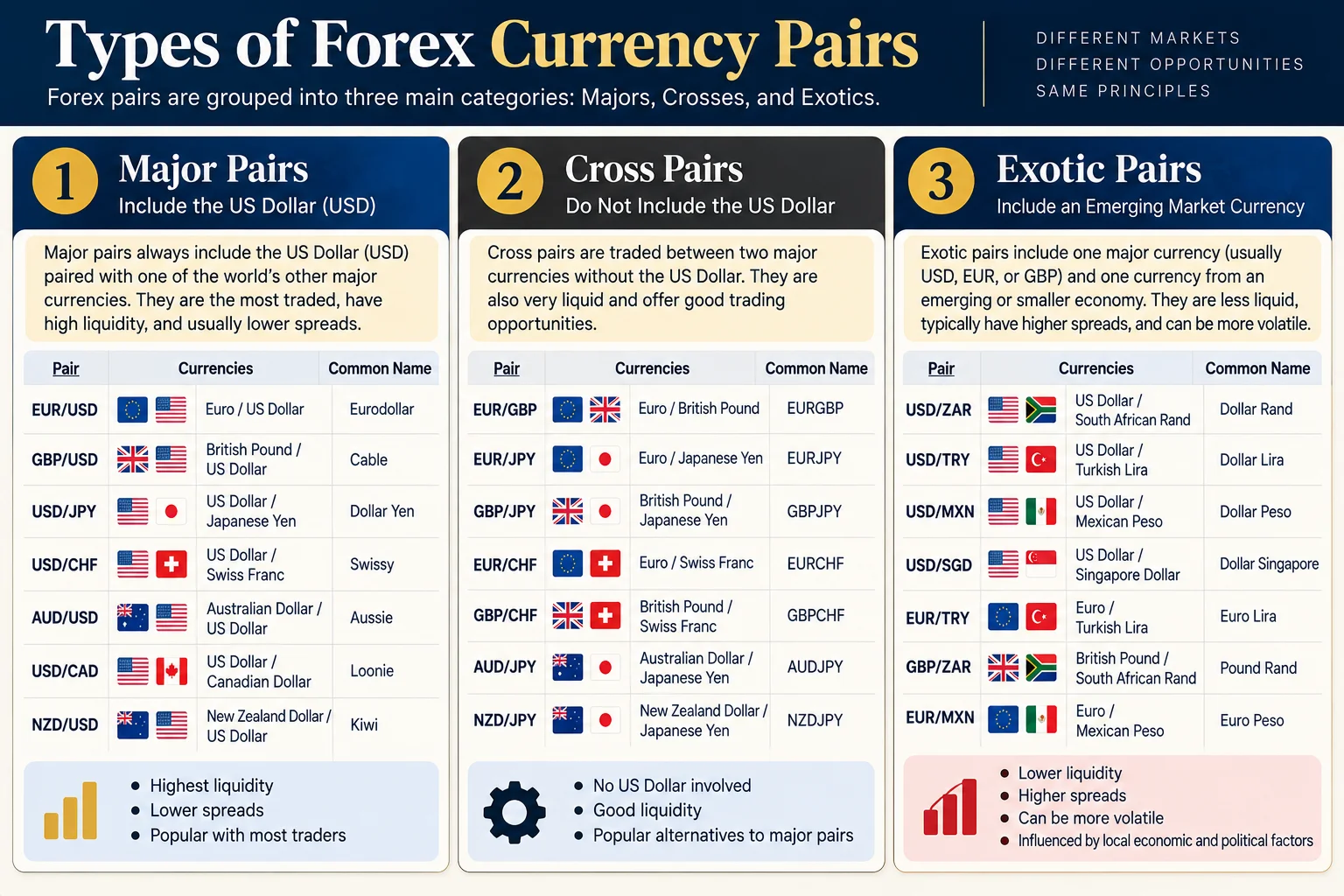
- Cable: GBPUSD, named after the old telegraph cable under the Atlantic that sent its price.
- Fiber: EURUSD.
- Aussie: AUDUSD.
- Kiwi: the name traders use when they talk about NZDUSD.
- Loonie: USDCAD, after the bird on the Canadian one dollar coin.
- Swissie: USDCHF.
- Guppy: GBPJPY.
Which of these pairs are cheap to trade, which ones move fast and which are best to learn on is a different question altogether, and I answer it in How Do Currency Pairs Work in Forex Trading?
Reading Price Quotes in Practice
Let us look at USD/JPY at 150.50. Here you are buying the Dollar and using 150.50 Yen to pay for it. If the price goes to 151.00, your Dollar is worth more and you have made money, but if it drops to 150.00, you have lost a bit.
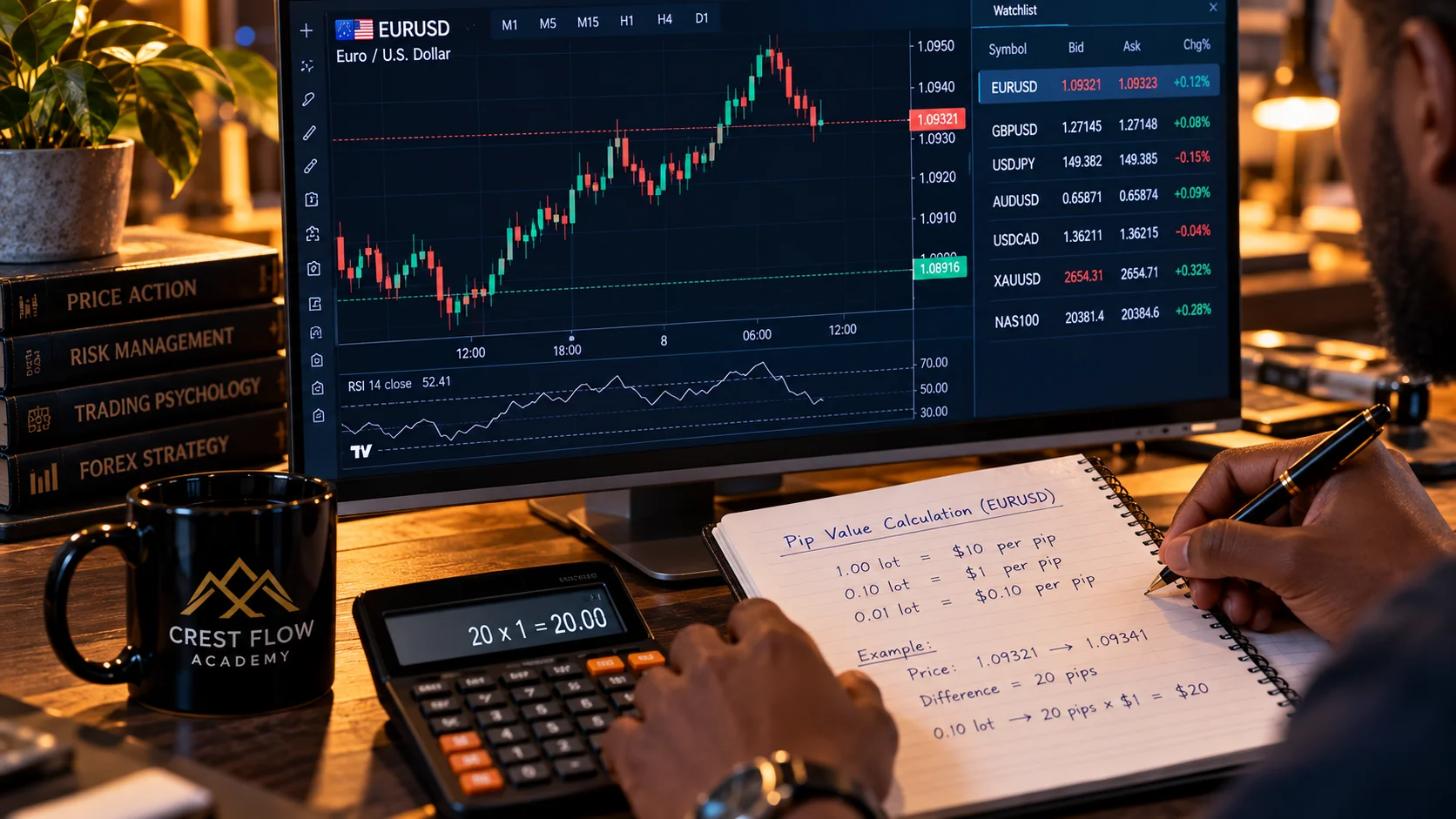
Now look at the number of decimals, because they matter more than most beginners think. Most pairs are quoted to five decimal places, like 1.08503. The fourth decimal is the pip, which is the standard unit traders count, and the tiny fifth decimal is a pipette, worth a tenth of a pip. Yen pairs work differently. Because one Yen is worth so little, they are quoted to three decimals, like 150.503, and the pip is the second decimal.
So a move from 1.08500 to 1.08600 on EURUSD is ten pips, and a move from 150.500 to 150.600 on USDJPY is also ten pips. Mixing these two up is exactly how beginners end up setting a stop ten times too close or ten times too far away. The full calculation,, is in What Is a Pip in Forex and How Do You Calculate It.
The Mistake Beginners Make With Currency Order
People often try to flip the pairs around in their head, so they want to see USD/EUR instead of EUR/USD. Please do not do this, because the order is fixed by the banks and it is simply the rule of the market.
When I read a chart, I look at the order exactly as it is written, and I never guess or flip the letters, because that is how calculation errors creep in. I am not your financial adviser, and this is only what has worked for me. Trading is about being precise, and if you cannot read the pair, you cannot trade the pair. When you feel ready to use all of this on a real account with a small amount, How to Start Forex Trading With $100: A Beginner Guide takes you through getting started one step at a time. If you are feeling confident now, How to Start Forex Trading With $100 Step by Step shows you how to put this knowledge into practice with a small account.
Where To Read Next
If you want to keep learning, these are the lessons I would pick up next.
- How to Start Forex Trading With $100 Step by Step
- How to Learn Forex Trading Step by Step for Beginners
- What Is Leverage in Forex Trading and How Does It Work?
- Is Forex Demo Trading Worth It for Beginner Traders?
- The Best Forex Brokers in 2026 and Which One to Use for What
- How to Read Forex Market Structure on a Raw Chart
Frequently Asked Questions
What do the letters in a forex pair mean?
They are ISO 4217 currency codes. Usually the first two letters stand for the country and the third for the currency, so JPY means Japan Yen. The first code in the pair is the one you buy or sell, and the second is the one you pay with.
Why is it EUR/USD and not USD/EUR?
The market uses a fixed priority order: EUR, GBP, AUD, NZD, USD, CAD, CHF, JPY. Whichever currency sits higher on that list always comes first.
Why does my broker show EURUSD.m or EURUSDm?
The ending marks the account type, such as a micro or raw spread account. The currencies stay the same, so just pick the symbol that matches your account.
What is Cable in forex?
Cable is the nickname for GBPUSD. It comes from the telegraph cable under the Atlantic that once carried the exchange rate between London and New York.
Why is USD/JPY quoted with fewer decimals?
One Yen is worth very little, so Yen pairs are quoted to three decimals and the pip is the second decimal. Most other pairs use five decimals, with the pip at the fourth.
How do I know if I am buying or selling a currency?
Buying the pair means you buy the first currency and pay with the second. Selling the pair means you sell the first currency and receive the second one in return.
If this helped you, send it to a friend who is learning to trade.